
No fleet? No problem.
Commercial EV chargers can still help your business thrive.
Find out how.

GET UP TO $90,000 IN INCENTIVES

Vehicle Incentives
Massachusetts businesses, schools, and organizations can claim state rebates ranging from $3,500 to $90,000 per truck.

Charging Incentives
Explore offers that can help bring the cost of chargers within reach for your business.
EVs for every kind of business
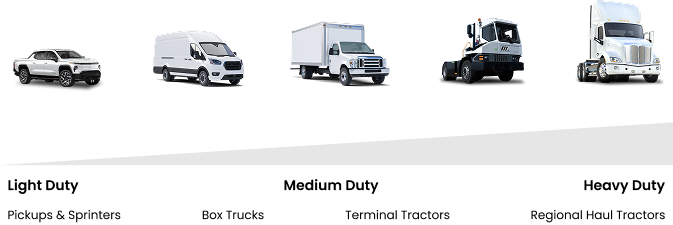
The state’s MOR-EV Truck Rebates cover 111 electric models (and counting). Explore the list of efficient, comfortable, and sustainable trucks that can help your business save.
Examples of qualifying commercial electric vehicles
Can’t find the vehicle type you need?
Explore all zero-emission vehicles here.
Cut your fuel and maintenance costs
Electric vehicles can cost significantly less to operate. They don’t need oil changes, they have fewer parts to maintain, and their brakes last longer thanks to efficient regenerative technology.
Aside from maintenance, electric vehicles cost less to fuel in MA. You can bring your fuel costs down even more by using solar panels on garage roofs to power your chargers.
Let’s talk numbers.
The fuel and maintenance savings of electric fleets depend on what vehicles you drive and how often they’re driven. Use this personalized calculator to see the costs and savings for yourself.
Ready to Go Electric?
Start with These Resources.

Free fleet transition support
The Mass Fleet Advisor can help you figure out if EVs are right for your fleet. If they are, the fleet advisor team can help you make a plan to electrify. The best part? There’s no purchase or commitment required.
Get help:
- Finding incentives and other funding opportunities.
- Prioritizing which vehicles would be most cost-effective to electrify.
- Understanding your electrical and infrastructure needs.
- Connecting with dealers to find the right vehicle(s).

Electrification checklist
Use this simplified list to make your switch to EVs go smoothly — so you can get back to business.
Download a step-by-step breakdown of:
- How to select the right vehicle(s) for your business.
- What to discuss with your electric utility provider.
- What to consider when selecting a charging site.
- Next steps once your site is set up.

Route planning
If your fleet covers lots of ground, you may need to charge on the road. Use an online route planner to map out different publicly accessible charging stops along the way.
With A Better Routeplanner’s tool, you can:
- Easily locate charging stations.
- Filter for amenities like nearby restrooms.
- Set your charge/ wait times.

The Advanced Clean
Trucks (ACT) Rule is here
More electric trucks will be on the market soon.
Why one local business is driving electric
"Midnight Our Seafood is extremely pleased with the purchase of a refrigerated EV delivery van. It allowed us to diversify our fleet, have a positive impact on the environment, and save money on fuel consumption."

ALL YOUR CHARGING QUESTIONS, ANSWERED
Ready to start planning your charging station?

HAVE MORE QUESTIONS?
LET'S CLEAR THEM UP.
Last updated March 2026
1. How long do EV batteries last? Can they be recycled?
Your EV battery will last for quite some time. All manufacturers currently offer at least 8-year or 100,000-mile warranties on EV drivetrains, including battery packs, although these warranties may allow for some loss of range over time. The Department of Energy also predicts today’s EV batteries will last 12-15 years. This number is only growing as EV technology develops.
If your EV battery does need to be replaced or retired, it can very likely be recycled (or even reused in another application). Most EV batteries use the same lithium-ion chemistry that powers smartphone and laptop batteries, which contain valuable metals that can be recovered and reused in new batteries. For more information on battery recycling, check out this resource: Everything You Need to Know about EV Battery Disposal.
2. If I'm not ready to buy EVs, can I lease them?
Yes! Leasing is a popular option for businesses because it's a great way to test if you're ready to electrify your fleet. The main benefits of leasing are:
- Lower upfront costs: Leasing is a great way to explore electrification without a major investment.
- Flexibility: You'll easily be able to adjust your fleet size or vehicle types as needed.
- Easy maintenance: Many leases include the cost of maintenance and services, so you'll have very predictable costs.
3. How safe and reliable are EVs? Does this change during the winter?
Overall, EVs are extremely reliable. Just like any vehicle, electric vehicles undergo thorough testing to meet Federal Motor Vehicle Safety Standards. Drivers can rest assured that EVs are just as safe as gas cars. In fact, EVs are even less prone to fires than gas vehicles. EVs also usually carry their battery packs on the bottom, which gives them a low center of gravity and makes it harder for them to flip. You can also research the reliability ratings of specific models you’re interested in before you make your purchase.
EVs are also very reliable during the winter. Just like gas vehicles, EV reliability in the winter depends on the model. There are a growing number of EV options on the market so you can choose vehicles with higher clearance or all-wheel drive to help your employees drive with confidence during snowstorms.
Another factor to consider in winter is driving range. When temperatures drop, any vehicle – gas or electric – becomes less efficient. Depending on the model and conditions, some EVs can temporarily reduce range by 30-50%. You can plan accordingly by preheating your EV while it’s plugged in, charging more frequently, and/or taking other measures recommended by the manufacturer to boost cold weather range.