
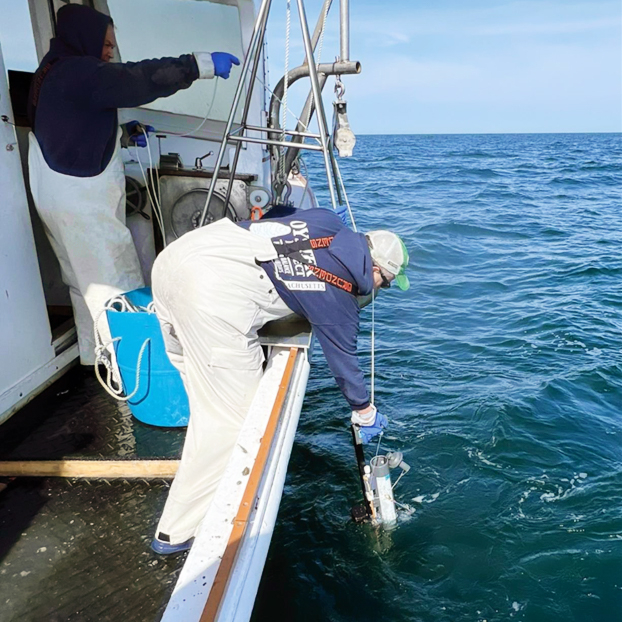
Gloucester Marine Genomics Institute (GMGI), a first-round Ocean Innovation Network (OIN) grantee, is a nonprofit working to better understand and protect ocean ecosystems while supporting human health and environmental sustainability through science and education.
With support from OIN, GMGI is launching an environmental DNA (eDNA) Service Platform and OceanTech Hub. These new facilities will give researchers and startups space to test technologies, study marine life using water samples, and bring new ocean solutions closer to real-world use.
Research Program Director Ann Petersen discussed GMGI’s mission, their involvement with OIN, and the projected impact of their work.
Read the interview below.
MassCEC: Can you tell us about your organization and mission?
Ann Petersen: [GMGI] is a visionary nonprofit that addresses critical challenges facing our oceans, human health, and the environment through innovative scientific research and education. By bringing world-class science and transformative workforce development to Gloucester’s historic waterfront, GMGI is catalyzing the regional economy.
At our state-of-the-art laboratories, we combine high-throughput (the ability to process a large number of samples or data points) molecular tools and strong partnerships with state agencies, NOAA, industry, and local fishermen to advance ocean science and create new opportunities for the North Shore. Our educational arm, the Gloucester Biotechnology Academy, trains local students for careers in the life sciences and contributes directly to regional job growth.
MassCEC: Can you explain what the eDNA Service Platform and OceanTech Hub are, and who they serve?
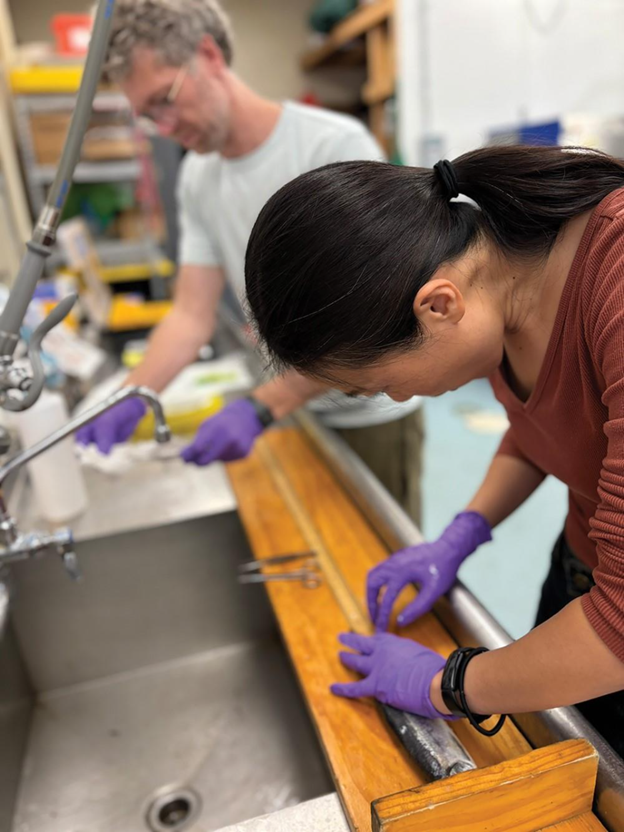
Petersen: The eDNA Service Platform is a dedicated, high-capacity facility for processing, sequencing, and analyzing environmental DNA samples. It serves researchers, state agencies, offshore wind developers, nonprofits, and private companies who need cost-effective, high-quality biodiversity and environmental monitoring data.
The GMGI OceanTech Hub is a collaborative wet-lab and seawater-testing space where our scientists, collaborators, clients, and regional startup affiliates can prototype new technologies, validate sensors or samplers, receive business and commercialization coaching, and work alongside GMGI researchers.
Together, these assets serve emerging OceanTech companies across Massachusetts and New England, particularly those needing access to seawater systems, lab spaces, genomics expertise, and a supportive entrepreneurial ecosystem.
MassCEC: How will the MassCEC funding be used to support this program?
Petersen: MassCEC funding is enabling the construction, equipping, and early operation of these new facilities.
Specifically, the support will:
- Build and outfit the dedicated eDNA Service Platform with specialized equipment for filtration, sequencing, data analysis, and sample storage.
- Upgrade and expand our seawater laboratory to accommodate more entrepreneurs, prototypes, and aquaculture-related testing.
- Create modular co-working wet and dry-lab spaces for startups and collaborators.
- Catalyze quarterly OceanTech networking and commercialization events, helping companies connect with partners, mentors, and the broader supply chain.
- Contribute funds to 2-3 startup companies through small scholarships to help pay for materials or staff salaries to come work alongside us in our space.
This investment kick-starts an innovative blue-economy hub on the North Shore that will become self-sustaining through service revenue and continued partnership growth.
MassCEC: What impact do you hope to see in the next year and beyond?
Petersen: Over the next year, we aim to stand up a fully operational eDNA Service Platform and begin serving new partners across Massachusetts. We expect to welcome startups and collaborators into the OceanTech Hub for product development, use of the seawater systems, and collaborative R&D. By 2026, we anticipate a growing community of regional innovators connecting with GMGI as their North Shore node for testing, training, and commercialization.
Long-term, this project positions the North Shore as a critical contributor to the Commonwealth’s blue economy — expanding job creation, enabling new technologies, and accelerating solutions that support climate resilience, sustainable fisheries, and ecosystem health. It will also support GMGI’s broader vision to build a “Virtual Living Ocean,” and digital-twin modeling platform for biodiversity across the Gulf of Maine.
MassCEC: Why is this work important for Massachusetts and your community?
Petersen: Massachusetts is a global leader in climate and ocean innovation, but the North Shore has lacked dedicated infrastructure for testing, validating, and commercializing new marine technologies. GMGI’s location on Gloucester Harbor, alongside vessels, scientists, and the fishing industry, fills this geographic and technical gap.
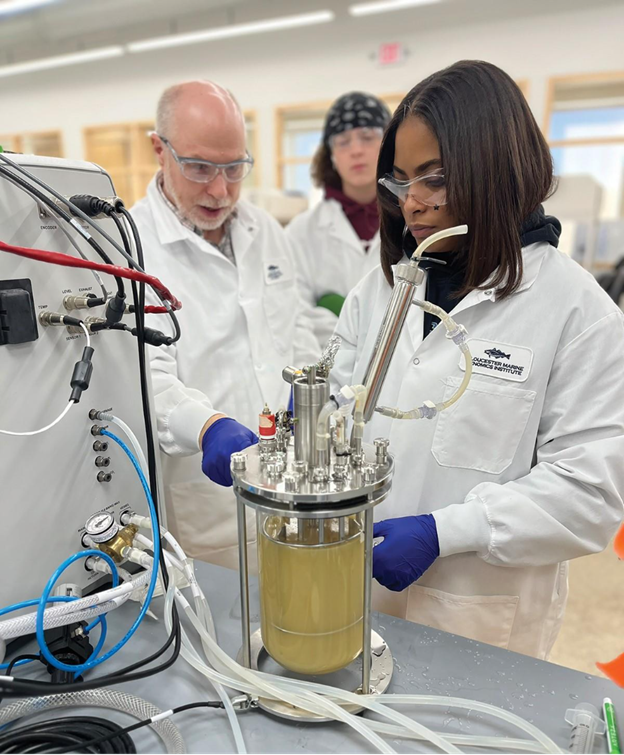
The project strengthens the Commonwealth’s climate-tech ecosystem by:
- Expanding access to high-quality biodiversity data, essential for fisheries, offshore wind, marine spatial planning, and climate adaptation.
- Providing affordable wet-lab and seawater testing space for entrepreneurs.
- Creating a new North Shore-based hub for innovation between Boston and Newburyport.
- Training a local workforce for emerging climate- and marine-technology industries.
For Gloucester, this investment brings new jobs, new companies, and new scientific capabilities to the region — directly supporting local economic resilience and the city’s maritime heritage.
MassCEC: What challenges does your community/industry face that this program helps address?
Petersen: OceanTech startups often lack access to seawater facilities, genomics expertise, and affordable lab spaces. These resources are essential for product development but difficult to find outside major research hubs. GMGI’s OceanTech Hub directly removes these barriers and creates new testing infrastructure for the state.
MassCEC: How does this program create opportunities for underrepresented groups or environmental justice communities?
Petersen: GMGI’s Biotechnology Academy provides tuition-free education and co-op opportunities for local young adults in the biotechnology space — many from underserved backgrounds — who will gain direct access to new jobs created through this initiative. The expansion of our facilities increases opportunities for trainees to work alongside scientists, startups, and industry partners in a rapidly growing field.
Through projects like GMGI’s OceanTech Hub and eDNA Service Platform, the Ocean Innovation Network is helping Massachusetts researchers, startups, and communities test and grow new ocean technologies. This work supports healthier marine ecosystems, stronger coastal communities, and new economic opportunities across the state. Visit the Ocean Innovation Network page to learn more.