
In the face of today’s climate impacts, ocean technology is crucial in creating solutions that safeguard coastal communities, make maritime industries more energy efficient, and protect marine environments. The Ocean Innovation Network (OIN), introduced by MassCEC in 2025, is designed to supercharge the path from early-stage ocean technology to real-world commercial solutions. By investing in oceantech research and development, OIN aims to give emerging companies the resources they need to test, refine, and scale cutting-edge solutions—making it easier for them to stay here in Massachusetts and create jobs.
The program also weaves together a stronger oceantech ecosystem, connecting startup companies and well-known organizations to fuel collaboration and mutual growth. Through OIN, MassCEC is accelerating Massachusetts’ rise as a global leader in ocean technology, strengthening connections across the South Coast, Cape Cod, and the North Shore.
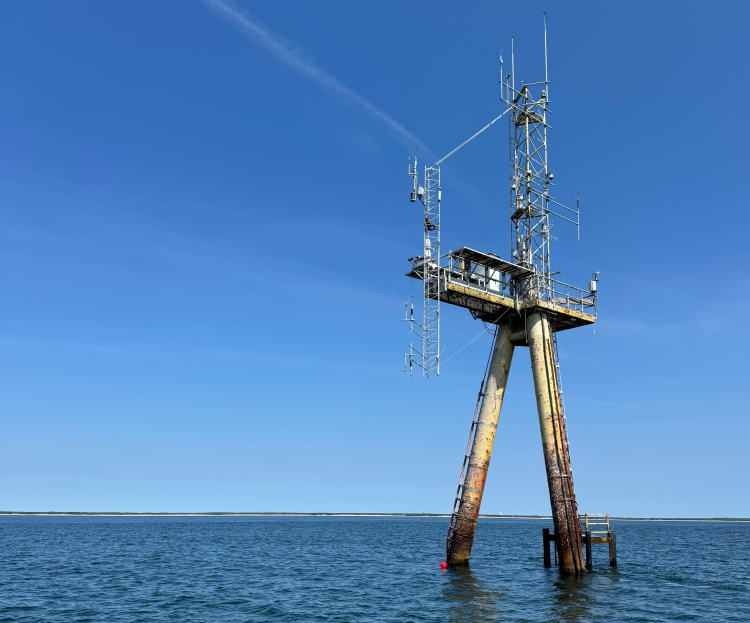
In the first round of OIN funding, over $11 million was awarded to seven oceantech organizations, including Woods Hole Oceanographic Institution (WHOI) in Falmouth, Massachusetts, which received over $3 million to develop its cutting-edge ocean test sites. As part of the OIN Testbeds program, these test sites will be available for oceantech companies to accelerate key research.
Anthony Kirincich, a senior scientist in WHOI’s Physical Oceanography Department, discussed WHOI’s involvement with OIN, the projected impact, and the importance of Massachusetts oceantech leadership.
Read the interview below.
MassCEC: Can you tell us about your organization and mission?
Anthony Kirincich: WHOI is the world’s largest private, nonprofit oceanographic research organization, with over 1,000 staff, students, and affiliated researchers and collaborators. Together, we make up one of the most diverse and experienced communities of ocean scientists and engineers anywhere. At the core, our mission is discovery and impact, helping to deepen knowledge of the ocean, training the next generation of ocean leaders, and advancing solutions that support a healthy, resilient planet.
MassCEC: What is Ocean Innovation Network (OIN): Testbeds, and who does it serve?
Kirincich: The Ocean Innovation Network Testbeds program is designed to give companies, whether they’re startups or more established firms, real access to the ocean environments they need to test and advance their technologies. Through OIN, innovators can put their systems in the water, see how they perform, troubleshoot challenges, and refine their designs with support from a community of experienced ocean scientists and engineers.
MassCEC: How will the MassCEC funding be used to support this program?
Kirincich: MassCEC’s support will allow us to expand and upgrade testing resources. With this funding, we’ll enhance existing infrastructure and build new capabilities across three test-bed sites, including dockside, nearshore, and open ocean/offshore, around New Bedford, Massachusetts, offering a range of real-world conditions that are typically tough for smaller companies to access on their own.
The funding will also make it easier for OIN users to access New Bedford Harbor, nearby coastal waters, and WHOI’s Air–Sea Interaction Tower (ASIT). That combination of environments will support everything from equipment validation to systems testing, helping innovators move toward commercialization more quickly.
MassCEC: What impact do you hope to see in the next year (or beyond)?
Kirincich: In the near term, we expect to see a stronger, more connected network of test sites that companies can rely on for regular, supported use. By working closely with MassCEC and our OIN partners, we’re aiming to bring all three sites fully online and integrated into day-to-day OIN operations.
Looking further ahead, our goal is to help make New Bedford and the surrounding region a global hub for ocean-technology testing and demonstration driving economic development, job creation, and leadership in the climate and blue economies.
MassCEC: Why is this work important for Massachusetts / WHOI?
Kirincich: Massachusetts has one of the most dynamic blue-tech and climate-tech communities in the world, but access to ocean testing remains one of the biggest challenges. By establishing shared and supported test beds, we’re lowering a major barrier. Companies get a reliable way to validate their technologies, build confidence with investors and customers, and move into the market faster and with more certainty.
For the state, this work reinforces its leadership in ocean innovation and supports the growth of a strong, skilled workforce. For WHOI, it strengthens our role as a convener and partner in advancing technologies that improve climate resilience, maritime safety, renewable energy, and long-term ocean stewardship.
As Massachusetts moves toward a clean energy future, our OIN partners demonstrate what’s possible when innovation, infrastructure, and collaboration come together with purpose. By sparking innovation and expanding access to world‑class testbeds, WHOI is strengthening the oceantech ecosystem and Massachusetts’ blue economy. MassCEC is proud to advance the work that makes Massachusetts a global leader in clean energy and oceantech.
Learn more about Ocean Innovation Network.