
Media Inquiries
Victoria King, MassCEC
617-315-9398
press@masscec.com
Funding will support efforts to modernize school bus fleets in Acton-Boxborough, Belmont, Boston, Chicopee, Lincoln, Newton, and Springfield
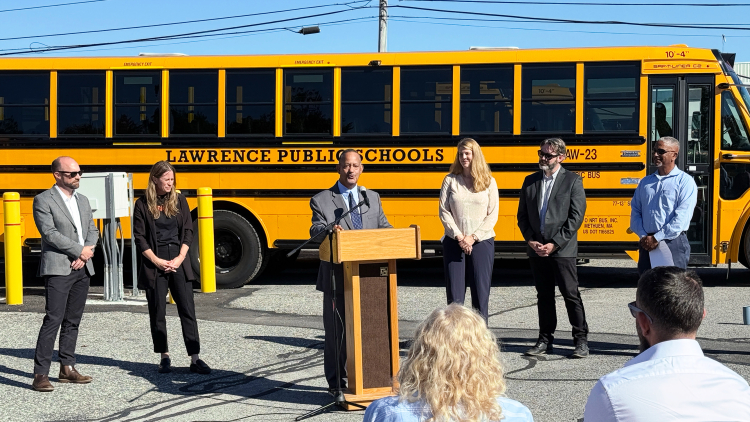
Speaker: Ralph Carrero, Superintendent of Lawrence Public Schools. Behind from left to right: Officials from National Grid, Zenobe, MassCEC, MassDEP, and a Bus Driver representative.
BOSTON – The Massachusetts Clean Energy Center today announced $11.7 million in funding for six school districts and private transportation providers as part of the fourth round of the School Bus Deployment program. This initiative supports communities putting dependable, modern electric school buses on the road, making transportation more reliable for students and more affordable for school districts.
“We’re helping school districts upgrade their buses and give our kids the best,” said Governor Maura Healey. “By electrifying school buses, we’re reducing pollution and making transportation more affordable for schools.”
“This funding helps school districts across Massachusetts modernize their fleets and cut operating costs, while creating good-paying jobs in the clean transportation sector,” said Lieutenant Governor Kim Driscoll. “It’s another example of how we’re putting energy solutions into action at the local level.”
The MassCEC School Bus Deployment program provides both financial support and hands-on technical planning assistance to ensure a smooth transition for school districts. The program also focuses on supporting high-need and environmental justice communities.
Round 4 Grantees:
-
Boston Public Schools - $2,500,000
-
Springfield Public Schools - $598,375
-
Acton-Boxborough Regional School District - $1,959,000
-
Student Transportation of America supporting Chicopee Public Schools - $2,390,000
-
Highland Electric supporting Belmont Public Schools - $1,839,013
-
Doherty’s Garage, Inc. supporting Lincoln and Newton Public Schools - $2,425,000
“The School Bus Deployment program gives communities the tools to provide cleaner, healthier transportation for students,” said Massachusetts Secretary of Energy and Environmental Affairs Rebecca Tepper. “This funding improves air quality and protects the long-term health of Massachusetts children and residents.”
“Reliable school transportation is essential to student success,” said Massachusetts Acting Secretary of Education Amy Kershaw. “Electric buses are a smart investment in the day-to-day experience of our students. They help districts modernize operations, reduce maintenance demands, and show young people what innovation looks like in their own communities.”
“School districts are eager to make the switch to electric buses, but the path isn’t always straightforward,” said MassCEC Interim CEO Dr. Jennifer Le Blond. “MassCEC is helping districts navigate that process—from evaluating vehicle options to planning charging infrastructure. With each new funding round, we’re strengthening statewide expertise and making electric school transportation more accessible and achievable for Massachusetts communities of all sizes.”
“School bus fleets are ideal candidates for electrification to reduce air pollution,” said MassDEP Commissioner Bonnie Heiple. “MassDEP is proud to support efforts to modernize the vehicles that safely transport Massachusetts' most precious resource—our future.”
To date, MassCEC’s School Bus Deployment program has funded projects to purchase 423 electric school buses across 20 districts and their transportation operators, representing a total investment of more than $34M. These projects reflect significant statewide momentum toward cleaner, healthier student transportation, while building practical experience in charging infrastructure, operations, and utility coordination. Together, these projects are reducing pollution, lowering long-term operating costs, and positioning Massachusetts as a leader in advancing school bus electrification.
For more information about MassCEC's Electric School Bus program, visit www.masscec.com/electric-school-bus-program-overview.
Statements of Support
“Electric school buses reduce pollution in our communities and in the air that students breathe every day before and after school,” said State Senator Jason Lewis (D-Winchester), Senate Chair of the Joint Committee on Education. “These grants will support municipalities as they invest in the future of clean energy and teach students about sustainable and renewable energy use.”
"Investments like these are needed to make progress in our efforts to decarbonize our transportation system," said State Senator Brendan Crighton (D-Lynn). "We thank the Healey-Driscoll Administration and the Massachusetts Clean Energy Center for supporting these transformative initiatives.”
About the Massachusetts Clean Energy Center
The Massachusetts Clean Energy Center is a state economic development agency dedicated to accelerating the growth of the clean energy and climatetech sector across the Commonwealth to spur job creation, deliver statewide environmental benefits, increase affordability, and secure long-term economic opportunities for the people of Massachusetts. Since 2010, MassCEC has awarded $990 million in programs and investments and attracted $3 billion in private and public funds.
###