
Media Inquiries
Victoria King, MassCEC
617-315-9398
press@masscec.com
Bi-directional EV chargers will turn vehicles into energy storage assets, advancing grid reliability and lowering energy costs for customers
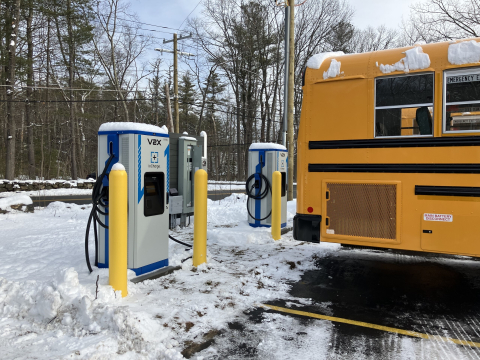
Two bi-directional chargers sit next to electric school buses at Acton-Boxborough Regional School District.
BOSTON – The Massachusetts Clean Energy Center (MassCEC) today announced the participants in a first-of-its-kind Vehicle-to-Everything (V2X) Demonstration program. Selected participants, including school districts, residents, and municipal projects, will receive bi-directional electric vehicle (EV) chargers at no cost. The program will help to accelerate the adoption of V2X technologies, which, at scale, can lower energy bills by reducing energy demand during expensive peak periods and limiting the need for new grid infrastructure.
Bi-directional charging enables EV batteries to both draw power from and return power to the grid or to buildings. This functionality enables EVs, including electric buses and trucks, to provide backup power during outages and alleviate pressure on the grid during peak energy demand. These bi-directional chargers will enable EVs to act as mobile energy storage assets, with the program expected to deliver over one megawatt of power back to the grid during a demand response event—enough to offset the electricity use of 300 average American homes for an hour.
“Virtual Power Plants are the future of our electrical grid, and I couldn’t be more excited to see this program take off. We’re putting the power of innovation directly in the hands of Massachusetts residents,” said Energy and Environmental Affairs Secretary Rebecca Tepper. “Bi-directional charging unlocks new ways to protect communities from outages and lower costs for families and public fleets.”
“The Vehicle-to-Everything Demonstration program shows how Massachusetts is leading the way in practical, scalable technological innovation that creates economic opportunities,” said MassCEC Interim CEO Dr. Jennifer Le Blond. “By enabling EVs to serve as energy resources, we’re helping families and schools take control of their energy. This is a real-world step toward a more reliable and affordable clean energy future.”
All bidirectional charging stations are expected to be installed and operational in the summer of 2026, with data collection continuing throughout the year. MassCEC will publish a comprehensive V2X Guidebook in late 2026, offering practical insights on cost, system design, charging management, and overcoming technical and regulatory barriers, giving stakeholders the tools they need to replicate and scale V2X deployments across Massachusetts and beyond.
This program addresses a critical gap in V2X adoption by providing and installing innovative infrastructure at no cost to participants across socioeconomic levels. Additionally, the program will help participants enroll in existing utility programs that offer compensation to EV owners who supply power back to the grid during peak times, helping participants further lower their electricity costs. By leveraging distributed energy resources and reducing grid strain, this program positions Massachusetts as a national leader in clean energy innovation.
The participants include:
-
5 school districts:
-
Acton-Boxborough Regional School District
-
Arlington Public Schools
-
Boston Public Schools
-
Concord Public Schools
-
Lincoln Public Schools
-
-
4 municipal projects:
-
Sterling Municipal Light Department
-
Town of Needham
-
Town of Plymouth
-
Town of Warwick
-
-
30 residents across the state. More than a third of the program's funding will support participants residing in environmental justice communities across the state.
For more information about the Vehicle-to-Everything Demonstration program, visit https://www.masscec.com/masscec-focus/clean-transportation/electric-vehicle-charging-infrastructure/vehicle-to-everything-demonstration.
Electric Vehicle Infrastructure Coordinating Council (EVICC)
Funding for this program was provided by the Healey-Driscoll Administration’s Electric Vehicle Infrastructure Coordinating Council (EVICC), as part of the award of $50 million from the American Rescue Plan Act to support EV charging initiatives across the Commonwealth.
EVICC is tasked with developing and implementing comprehensive electric vehicle charging infrastructure deployment strategies for the Commonwealth. EVICC identifies these strategies and related analysis through biennial Assessments; the most recent Assessment was released in August 2025.
Statements of Support
“Innovative programs like this one are exactly what Massachusetts needs to meet our clean energy goals while strengthening grid reliability in every corner of the Commonwealth,” said State Senator Paul Mark (D-Becket). “By investing in Vehicle-to-Everything technology, we’re empowering residents, schools, and municipalities—from Williamstown to Boston—to take part in building a more resilient and sustainable energy future. I’m grateful to see communities in Western Massachusetts included among the first participants leading the way.”
“As we continue to find clean, innovative ways to supplement our electrical grid, the Vehicle-to-Everything Demonstration program will serve as a new aide in reducing energy costs,” said State Senator Brendan Crighton (D-Lynn). “Thanks to the Healey-Driscoll Administration and the Massachusetts Clean Energy Center for supporting these multi-faceted initiatives.”
About the Massachusetts Clean Energy Center
The Massachusetts Clean Energy Center is a state economic development agency dedicated to accelerating the growth of the clean energy and climatetech sector across the Commonwealth to spur job creation, deliver statewide environmental benefits, increase affordability, and secure long-term economic opportunities for the people of Massachusetts. Since 2010, MassCEC has awarded $990 million in programs and investments and attracted $3 billion in private and public funds.
###