
Media Inquiries
Victoria King, MassCEC
617-315-9398
press@masscec.com
Effort will explore innovative use of local waterways to deliver clean energy for heating and cooling to lower energy costs
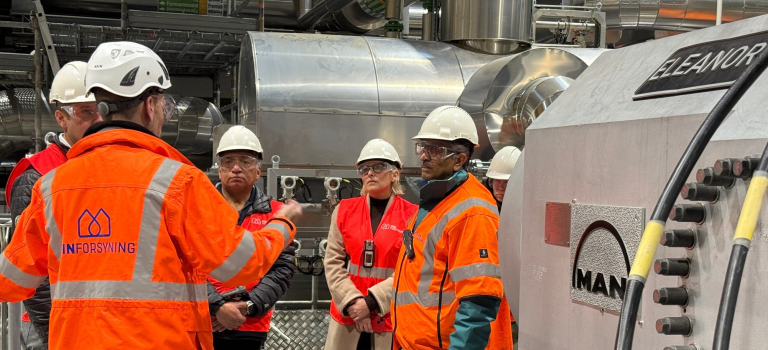
The Boston Green Ribbon Commission delegation visits the seawater heat pump system in Esbjerg, Denmark in 2025.
BOSTON – The Mass Clean Energy Center, in partnership with the City of Boston, today announced $500,000 in funding for the Boston Green Ribbon Commission (GRC) to lead a project exploring the technical, economic, and regulatory feasibility of using clean thermal energy from Boston-area water to deliver large-scale heating and cooling. The year-long Boston Thermal Energy Network (BosTEN) Project aims to demonstrate that thermal energy networks (TENS) can deliver long-term cost savings, reduce pollution, and mitigate peaks on gas and electric systems as Massachusetts continues to transition to a clean energy economy.
“Massachusetts is where we come together to solve big challenges, and this project is a perfect example of that. This is about making energy more affordable and more reliable for the people and businesses of Massachusetts,” said Governor Maura Healey. “Thermal energy networks offer a smart, scalable way to meet growing demand while cutting pollution and easing pressure on our grid. We’re proud to partner with the City of Boston and regional leaders to move this forward.”
“Large buildings account for a significant share of our energy use, and they need heating and cooling solutions that are reliable, scalable, and cost-effective,” said Lieutenant Governor Kim Driscoll. “This groundbreaking effort positions Boston to lead on innovative infrastructure that can serve major energy users while easing pressure on our broader energy system.”
The BosTEN Project will explore how to capture thermal energy from the Charles and Mystic Rivers, Boston Harbor, the Fort Point Channel, and the bedrock beneath the rivers, and deliver it to nearby large buildings for clean heating and cooling. The closed system of a thermal energy network circulates heat through sealed infrastructure without drawing water from waterways, avoiding impacts to marine life. These networks, which are already in use across Canada and Europe, can help reduce strain on the electric grid as energy demand grows.
“This innovative effort reflects what Boston does best: bringing together some of our region’s most valuable partners to make our city more sustainable and affordable,” said Boston Mayor Michelle Wu. “By exploring thermal energy, we’re opening an opportunity to keep our buildings comfortable year-round while maintaining stable electricity costs and paving the way for other cities across the Commonwealth to do the same.”
The BosTEN project will leverage the Green Ribbon Commission’s diverse membership, which represents many of the area’s largest energy users, including universities, hospitals, commercial real estate, and public agencies, to obtain data on their buildings. This data will help shape The BosTEN Project’s analysis of thermal energy use at scale throughout the region.
The GRC will also work with government entities, regulated utilities, and district energy providers to address underground infrastructure and regulatory barriers. The goal is to create an approach that is practical, equitable, and applicable to many sites statewide.
“Massachusetts already has a strong workforce poised to build the thermal energy networks we need to heat and cool our buildings,” said Energy and Environmental Affairs Secretary Rebecca Tepper. “Our colleges, hospitals, and businesses are leading the way in advancing affordable clean energy solutions at scale. We’re excited to work with the Green Ribbon Commission and the City of Boston to explore this opportunity.”
“Massachusetts is the world’s climate innovation lab. This project is another example of Boston, our capital city, taking control of its energy future. Thermal energy networks are an exciting potential path to reduce energy costs and address growing demand for heating and cooling powered by clean energy,” said Mass Clean Energy Center CEO Ben Downing. “The BosTEN Project will deepen our understanding of how these systems can strengthen our grid, manage peak demand, and make Massachusetts more energy independent.”
“What makes this ambitious project tangible is the amount of collaboration behind it,” said Dr. Lindsey Butler, Executive Director of the Green Ribbon Commission. “By bringing together our most influential institutions, largest energy users, public entities, and engineering experts, we will be able to deliver insights that could make thermal energy networks a reality that benefits communities across Massachusetts and serves as a global example of what’s possible.”
At the end of the project, the Green Ribbon Commission will deliver findings on thermal supply, distribution pathways, phased demand among early adopters, investment readiness, and permitting/regulatory requirements, with an emphasis on producing near-term pilot concepts that can be enacted in Boston.
The Green Ribbon Commission is seeking a qualified engineering firm or technical consultant to lead this work. To learn more and apply, visit greenribboncommission.org/2026/04/cleanthermalrfp; proposals are due April 29.
Governor Healey’s Energy Affordability, Independence & Innovation Act uses innovative financing to significantly reduce the upfront costs of geothermal projects for energy users, which are significantly more affordable to operate once built. This change is ideal for large colleges, businesses, and hospital campuses looking to lower their energy use, costs, and emissions. Governor Healey also recently signed an Executive Order to increase Massachusetts’ energy supply. Her Executive Order directs state agencies to identify opportunities for geothermal energy, expedite licensing and permitting, and address other hurdles to advancing thermal energy sources in Massachusetts.
For additional information on The BosTEN Project, visit masscec.com/accelerating-decarbonization/net-zero-grid/bosten.
Statements of Support
“Thermal energy networks are a critical piece of the “all of the above” approach to powering the commonwealth, which is why both the Governor and the House of Representatives included strong geothermal provisions in our energy affordability bills,” said State Representative Mark Cusack, House Chair of the Joint Committee on Telecommunications, Utilities and Energy (D-Braintree). “This project highlights the exciting potential of geothermal and thermal energy networks to deliver affordable and reliable heating and cooling at scale. These systems can reduce long-term energy costs and reduce strain on both the electric and gas systems, which is ever more critical given the increasingly volatile global energy market.”
“Water-sourced thermal energy networks have proven around the world to provide affordable, reliable, and renewable energy for buildings and neighborhoods,” said Brian Swett, Chief Climate Officer for the City of Boston. “With our extensive Boston Harbor shoreline and major rivers, I’m excited to evaluate the potential for such thermal energy networks in Boston as we create an energy grid that supports a decarbonized, resilient, and affordable Boston for all to thrive in.”
“As Greater Boston’s largest organizations continue to make great progress toward individual climate goals, it is evident that the scale of the challenge will benefit from an innovative, broad-based approach,” said Dennis Carlberg, AIA, LEED AP, Chief Sustainability Officer, Boston University and Co-Chair of the Boston Green Ribbon Commission Higher Education Working Group. “The MassCEC and City of Boston partnership will enable us all to work together to solve it. This collaborative partnership is our chance to tackle the affordability and climate challenge through the development of city-scale clean thermal energy networks.”
“Mass General Brigham sees firsthand how climate and environmental conditions – including extreme heat and air pollution – affect patient health,” said Dennis Villanueva, Director of Energy Strategy & Procurement at Mass General Brigham. “The BosTEN Project reflects the kind of collaborative, forward‑looking approach Boston needs – supporting the city’s decarbonization goals while advancing healthier communities. We are proud to support an effort with the potential to reduce emissions locally and serve as a model for cities nationwide.”
“It’s a bold idea. We know it can work – we’ve seen it firsthand during our visits to district-scale thermal networks in Denmark and Germany,” said Joe Higgins, Vice President for Campus Services and Stewardship, Massachusetts Institute of Technology. “Now we want to understand how to design these systems locally and yield similar benefits for our campuses and communities. We’re eager to dig into the technical aspects of tapping into these heat sources and linking them through a connected network.”
About the Mass Clean Energy Center
The Mass Clean Energy Center is a state economic development agency dedicated to accelerating the growth of the clean energy and climatetech sector across the Commonwealth to spur job creation, deliver statewide environmental benefits, increase affordability, and secure long-term economic opportunities for the people of Massachusetts. Since 2010, MassCEC has awarded $990 million in programs and investments and attracted more than $3 billion in private and public funds.
###