
What is SMART 3.0?
Did you know that if you are eligible for the Solar Massachusetts Renewable Target (SMART) program, you can receive payments for the solar electricity produced by your solar panels in addition to the energy costs you offset?
SMART is an earn-as-you-produce incentive program that compensates solar system owners with monthly payments from their electric utility. It was launched in November 2018 by the Department of Energy Resources (DOER) and Eversource, National Grid, and Unitil. Since then, SMART has been Massachusetts’ primary financial incentive program for solar electric projects.
In 2025, DOER completed a review of the SMART program and launched an updated version called SMART 3.0. Under SMART 3.0, incentive rates will be adjusted each year based on market conditions. This will help ensure that each new iteration of the program responds to the changing costs of solar development. Once you join the program, your incentive rate is “locked in,” or stays the same, for the term of your participation.
To put it simply, the SMART program is an opportunity to earn revenue from your solar system. You can continue receiving payments for up to 20 years after installation. See the sections below for information on eligibility, how your rate is calculated, the application process, and more.
Where is SMART 3.0 available?
The SMART program is available to customers of Investor-Owned Utilities, which are National Grid, Eversource, and Unitil. Use this map of electric utility coverage to see who your electric utility is, if you aren’t sure.
If you live in a town with a Municipal Light Plant (MLP), you are not eligible for SMART, but you can check if your utility offers its own incentive. Not sure if your community is served by an MLP? Visit this list of towns and cities served by MLPs, and if your community is on the list, search your MLP’s website for solar incentives or rebates.
How does SMART 3.0 work, and how do you participate?
Eligibility
Residents are eligible for SMART 3.0 if they satisfy both of the following criteria:
- Have not previously received incentives under SMART or the Renewable Portfolio Standard (RPS)
- Started on-site construction of a solar system on or after June 20, 2025
Application Process
Taking advantage of SMART is simple. All you have to do is let your solar contractor know that you want to participate. They will then apply for the SMART incentive on your behalf, reserving your spot in the current program year. Note that as part of the SMART program, contractors are obligated to provide you with a Customer Disclosure Form containing essential project details. Make sure you’ve received and reviewed the Direct Ownership Disclosure form before signing your contract.
For assistance finding an contractor visit our Find a Clean Energy Professional Directory, where you can search for solar contractors near you. You can also view a list of contractors that have recently installed systems in Massachusetts via our Solar Cost Comparison Tool, which can be sorted by contractor, county, or year to help you compare costs of similar systems in your area. We also have Tips for Finding and Selecting a Solar Contractor and a Checklist of Questions you should ask during the process. MassCEC recommends seeking quotes from multiple contractors to help you best consider available options and pricing for your system.

Your Incentive Rate
To make things easier for residential participants, SMART 3.0 establishes a flat incentive rate for most residential solar systems (25 kW or smaller).
- In 2026, the base incentive rate is $0.03 per kilowatt-hour (kWh).
- Low-income qualified customers will receive a higher rate of $0.06 per kWh.
- Once you qualify for the program, your rate is locked in for 20 years.
Note that these rates may change in subsequent years. Your contractor should provide you with the most appropriate and up-to-date rate for your specific project before you sign a contract, and you can find these numbers at any time on DOER’s website.
Incentive rates will be calculated differently for non-residential projects that are larger than 25 kW. Information on rates for these projects can be found in DOER’s Annual Program Year Reports, which will be published on the SMART 3.0 website.
Receiving Payments – Checks from Your Utility or Credits on Your Bill
When your system is approved for participation, you can receive incentive payments for up to 20 years. You can choose to receive these payments as checks directly from your utility, or receive them as credits on your utility bill.
For small systems, solar incentive payments received through SMART are earned in addition to any net metering credits on your monthly bill. Net metering is a billing mechanism that credits solar energy system owners for the electricity they add to the grid by allowing them to sell any extra power they do not use back to the utility. When the system owner creates more than they use, it’s documented on their electric bill as net metering credits and applied towards future bills. EnergySage has a helpful video to explain net metering. You can participate in net metering while also taking advantage of the SMART program – this means that the incentive payments you receive from SMART would be on top of the savings you see on your electricity bill from net metering. For specific questions about net metering at your residence, contact your electric utility.
It’s important to note that the solar system owner receives ongoing SMART incentive payments (this will generally be the case with any solar incentive program). If you are interested in a third-party ownership model of solar, such as a lease or power purchase agreement, you should contact the third-party owner of your system to understand how any SMART incentives will factor into your monthly payments.
Please note that the issuance of SMART 3.0 incentive payments require approval of a utility payment mechanism. This payment mechanism must be approved by the Department of Public Utilities (DPU). While there is no definitive timeline for when the DPU will approve the payment mechanism, DOER expects resolution in 2026. Projects that become operational before the DPU approval can still receive Net Metering credits in the meantime.
When does SMART 3.0 open?
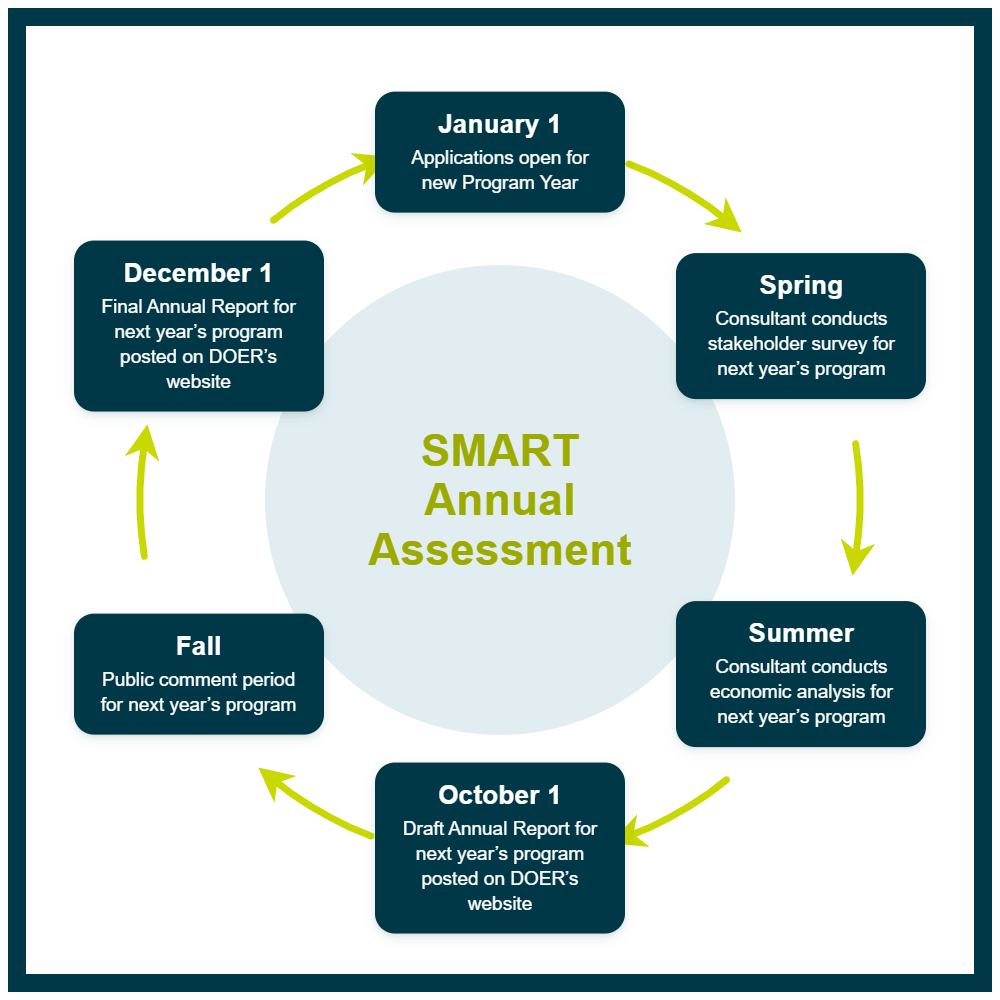
DOER began accepting applications for the 2026 Program Year of SMART 3.0 on January 1, 2026. Applications for each new Program Year will open on January 1 and be processed in the order they are received. Each new Program Year’s design is based on the previous year’s market and stakeholder analysis, ensuring that the program is responsive to changing market conditions (but remember that once you enter the program, your personal incentive rate is locked in).
Why should you participate in SMART 3.0?
Earn Revenue from Your Solar System
Participating in SMART is a personal decision that depends on your specific situation. If your project is eligible and you are interested in earning revenue to help pay back the cost of your system, or if you would like to be compensated for your contribution to Massachusetts’ clean energy portfolio, you should consider participating.
New Benefits with SMART 3.0
SMART 3.0 provides new benefits and consumer protection measures compared to previous iterations of the program. Most notably, the flat incentive rate will be re-evaluated each Program Year and adjusted as needed, to ensure that each iteration of the program fairly reflects market conditions at the time. Additionally, you can now receive payments for 20 years as compared to the 10-year duration of the previous SMART program. Below are some goals of SMART 3.0:
SMART 3.0 Program Goals
-
More responsive to quickly changing market conditions
-
Increase transparency, consumer protections and benefits, equitable outcomes
-
Ensure strategic balance of cost-effective development with land protection
-
Better program tracking and enforcement actions for non-compliance
Participation in SMART 3.0 vs. Participation Directly in the REC Market
In Massachusetts, the foundation of solar incentive programs are Renewable Energy Certificates (RECs). A REC represents the environmental benefit of producing clean electricity — your system earns one REC for every megawatt-hour of power it generates.
By participating in SMART, the RECs associated with your system are assigned to your electric utility for the term of your participation in the program, helping the company meet its renewables targets. Your SMART incentive payment is intended to compensate you for this service. The alternative to participating in SMART is directly selling your system’s RECs to electricity suppliers on an open market called the “Class 1 REC Market,” with help from your contractor or an “aggregator.” However, REC prices can go up or down based on market conditions.
While there is no definitive answer as to whether you would be compensated more from participation in SMART or participation directly in the REC market, the intended benefit of participating in SMART is that you get predictable and reliable payments. It ensures you continue to see a positive incentive value for your system and are fairly compensated for the benefits the system adds to Massachusetts’ renewable energy portfolio. This removes an element of risk and strengthens consumer protection, particularly for residential systems.
Who should you talk to if you have questions about SMART?
Visit the SMART webpage for general program information. If you have additional questions about SMART, you can reach out to the program administrators at MA.SMART@clearesult.com or doer.smart@mass.gov.
Interested in other clean energy home improvements? Visit Clean Energy Lives Here.