
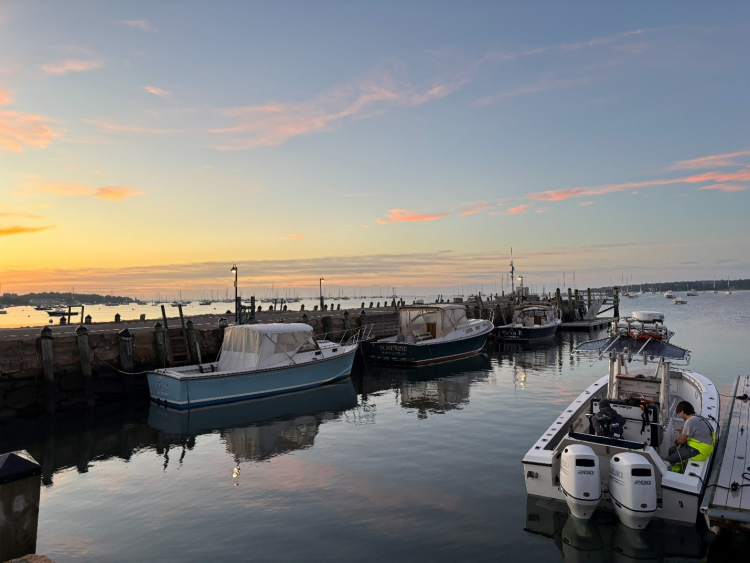
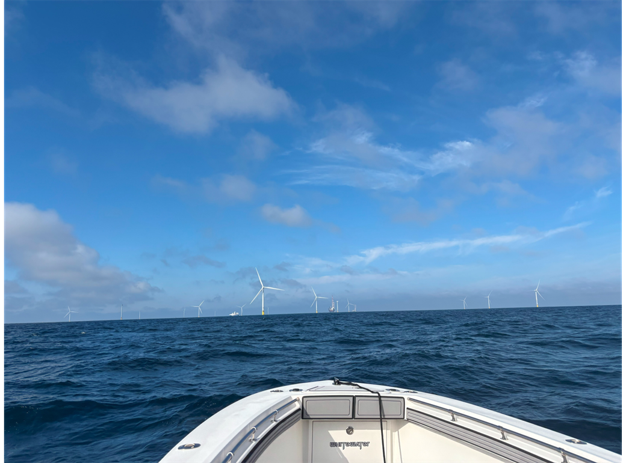
We arrive at Mattapoisett Town Wharf before the sun rises and gear up for a day on the water. As we make our way out of the harbor toward the offshore wind lease areas, we pass many fishing vessels across Buzzards Bay and around Martha’s Vineyard. Soon we see turbines dotting the horizon in the day’s early light. Against this backdrop, our field work takes on added importance: Are marine life biodiversity and distribution patterns changing during the construction and operation of offshore wind farms, and if so, how?
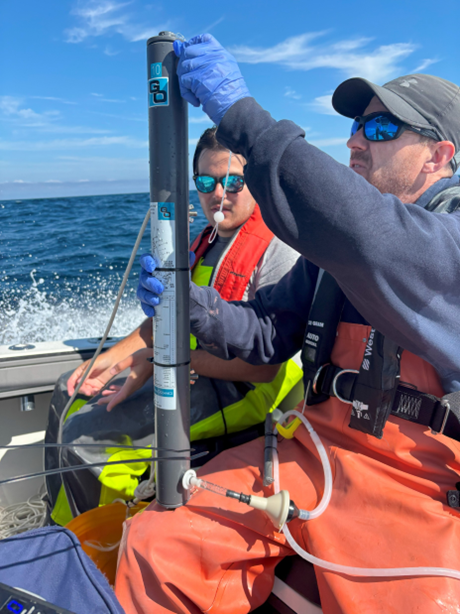
When we get to our first sampling station, along with our captain, we become a three-person water sampling pit crew. While one of us filters surface water, another drops a water sampler to the seafloor to capture bottom water. Because different marine communities inhabit surface and bottom waters, it is important that we sample both. By the end of the day, we will have traveled over 130 miles and filtered water samples from nearly half of our 44 sites — not bad for a day’s work! The samples we’ve collected will be used to provide information on the biological communities associated with the waters in and around the offshore lease areas. Our project relies on an emerging technology that allows us to study fisheries and biodiversity with minimal disturbance: environmental DNA.
Building a Regional Monitoring Program
Environmental DNA, or eDNA, refers to genetic material that organisms naturally shed into the environment through skin cells, waste, or mucus. By collecting and filtering seawater, we can detect traces of this eDNA and identify a wide range of species— from commercially important fish and invertebrates to marine mammals, seabirds, and sea turtles — without deploying nets or traps. This approach is especially well suited for offshore wind areas, where traditional sampling gear can be challenging to deploy during construction.
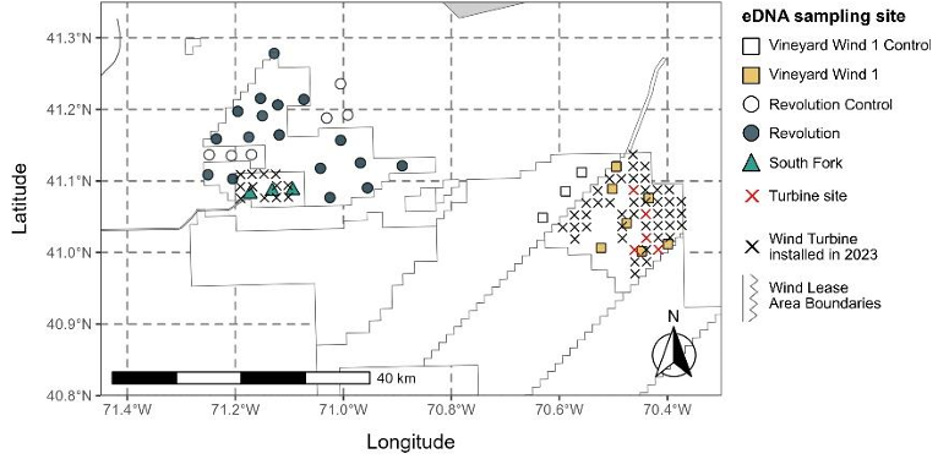
In 2023–2024, Gloucester Marine Genomics Institute (GMGI) partnered with the Massachusetts Division of Marine Fisheries (MA DMF) to launch an eDNA monitoring program across three offshore wind lease areas. This monitoring plan includes 27 sites within active lease areas and 13 sites outside of the lease areas. Samples are being collected before, during, and after construction.
With support from the Mass Clean Energy Center, we have now expanded this effort through 2025–2026 to capture post construction conditions. Field sampling is led by MA DMF scientists working aboard a Massachusetts charter fishing vessel, while GMGI conducts the laboratory and bioinformatics analyses at its research institute on Gloucester Harbor. We’re also coordinating closely with the Responsible Offshore Science Alliance (ROSA) to integrate our results with other regional monitoring efforts and ensure findings are shared widely with stakeholders.
Several later-stage offshore wind projects are overseeing individual monitoring plans required by their permits. However, coordinated monitoring across multiple lease areas has been limited, making it difficult to evaluate potential changes in marine species distribution across the Nantucket Shoals region as a whole. Our eDNA survey helps to bridge this gap, as it spans several lease areas, providing spatial distribution information on fish species within and surrounding offshore wind farms.
Collecting Samples at Sea
Between May and November 2025, we collected monthly surface and bottom water samples at 44 offshore sites. Water was filtered at sea using a specialized eDNA sampler, capturing genetic material suspended in the water column. Environmental conditions like temperature, salinity, and dissolved oxygen were recorded at each station, providing critical context for interpreting biological patterns.
Working offshore always comes with surprises such as changing weather, shifting tides, and tight sampling windows, but the flexibility of eDNA sampling has proven to be one of its greatest strengths. Even during active turbine installation, we’ve been able to collect consistent data across sites and seasons. In addition to offshore wind work crews and vessels, we often have the chance to see firsthand some of the species that will turn up in our eDNA samples. The backdrop to water sampling has included breaching humpback whales, pods of common dolphins on the go, and schools of mahi-mahi crashing on the surface.
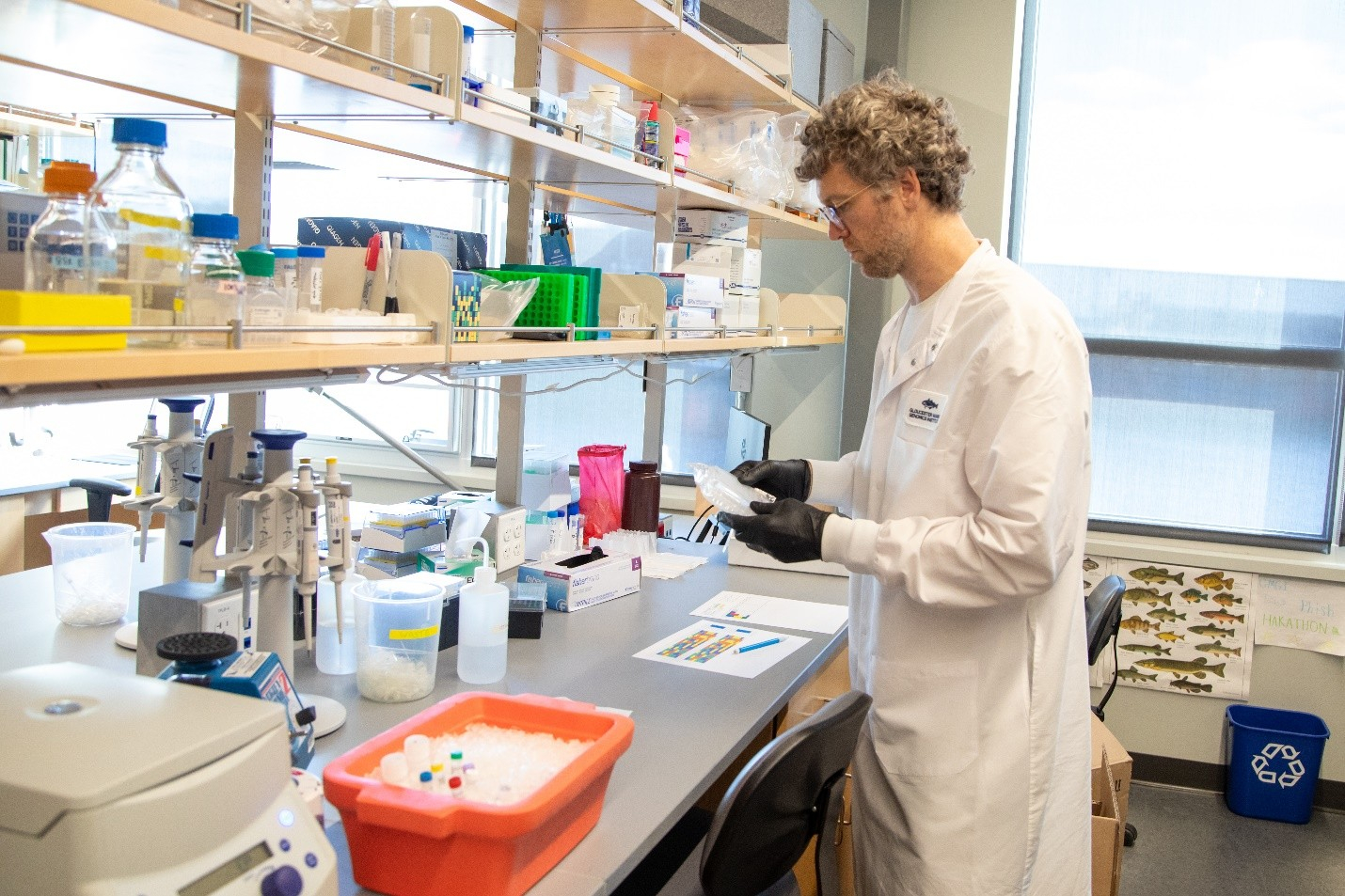
Back at the lab, GMGI researchers extract DNA from the filters and use a laboratory protocol called metabarcoding that sequences one region of DNA to taxonomically identify organisms found in our sample. Using these methods, we can analyze how vertebrate and invertebrate communities are changing seasonally and during construction of large offshore wind farms.
What the Data Is Starting to Show
Early results from the 2023–2024 surveys revealed nearly 150 vertebrate species across the study area, including bony fish, sharks and rays, marine mammals, seabirds, and sea turtles. One standout finding was the widespread detection of sand lance, a small but ecologically critical forage fish for larger fish, whales, and seabirds that are notoriously difficult to sample with traditional surveys.
As we continue sampling through the post construction phase, we’ll be able to examine how species distributions shift over time, and how physical changes and underwater noise may influence marine communities. Additional sampling and ongoing analyses will help us identify patterns in species distributions and which biological, physical, and chemical factors may have contributed. Together, these insights will help inform fisheries management, environmental planning, and future offshore wind development.
Where the Research Goes From Here
Over the next two years, our team will continue collecting and analyzing data across all phases of offshore wind development. By the end of the project, we aim to deliver an assessment of marine biodiversity associated with all phases of construction and operation of offshore wind in southern New England. By pairing innovative genomic tools with collaborative research, we can support a future where clean energy, healthy oceans, and resilient fisheries thrive together.
To follow project updates and related research, visit Gloucester Marine Genomics Institute and Massachusetts Division of Marine Fisheries online.