
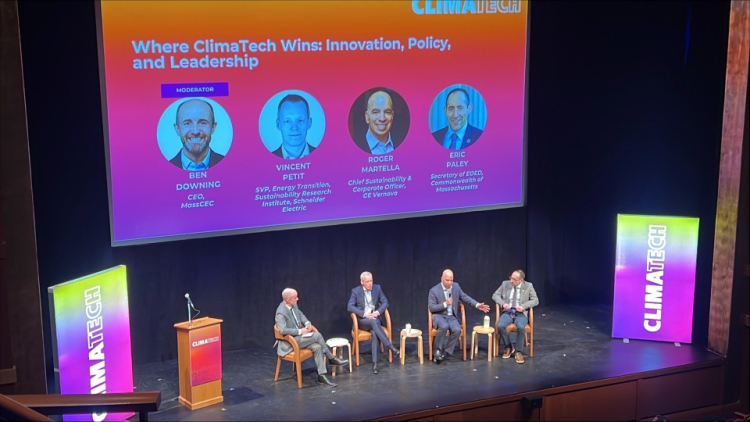
As Massachusetts marked Climate Week, Mass Clean Energy Center staff and new CEO Ben Downing shared their insight and goals for the future. Across ClimaTech conversations, one theme came through clearly: the state has built one of the strongest climate innovation ecosystems in the world, but the next phase is about turning that innovation into impact at scale.
There is a growing sense of both progress and pressure. From early-stage commercialization to the future of the built environment and the broader competitiveness of the state, three discussions highlighted what climate innovation needs now, and the critical role MassCEC plays in making it happen.
Crossing the “First-of-a-Kind” (FOAK) Gap
In a roundtable focused on commercialization, investors, founders, and corporate leaders pointed to a familiar but persistent barrier: the “first-of-a-kind” (FOAK) gap. Many promising climate technologies struggle to move from prototype to real-world deployment, where risk remains high and capital is harder to secure.
Startups are increasingly caught in the “missing middle”, too advanced for early-stage funding, but not yet proven enough for large-scale investment. At the same time, corporations are interested in innovation but often lack clear pathways to engage early.
Massachusetts is addressing this challenge directly. MassCEC’s Critical Mass program is designed to support demonstration projects that validate technologies in real-world conditions, helping companies cross that critical threshold from concept to commercialization.
But as participants noted, demonstration is only part of the solution. To truly unlock scale, the ecosystem must align around what comes next: procurement pathways, committed customers, and clearer signals to investors.
“Massachusetts has always been exceptional at generating breakthrough ideas,” said Ben Downing. “Our focus now is making sure those ideas don’t stall before they reach the market. Programs like Critical Mass are about proving what works and then building the pathways to scale it.”
Building the Systems to Scale
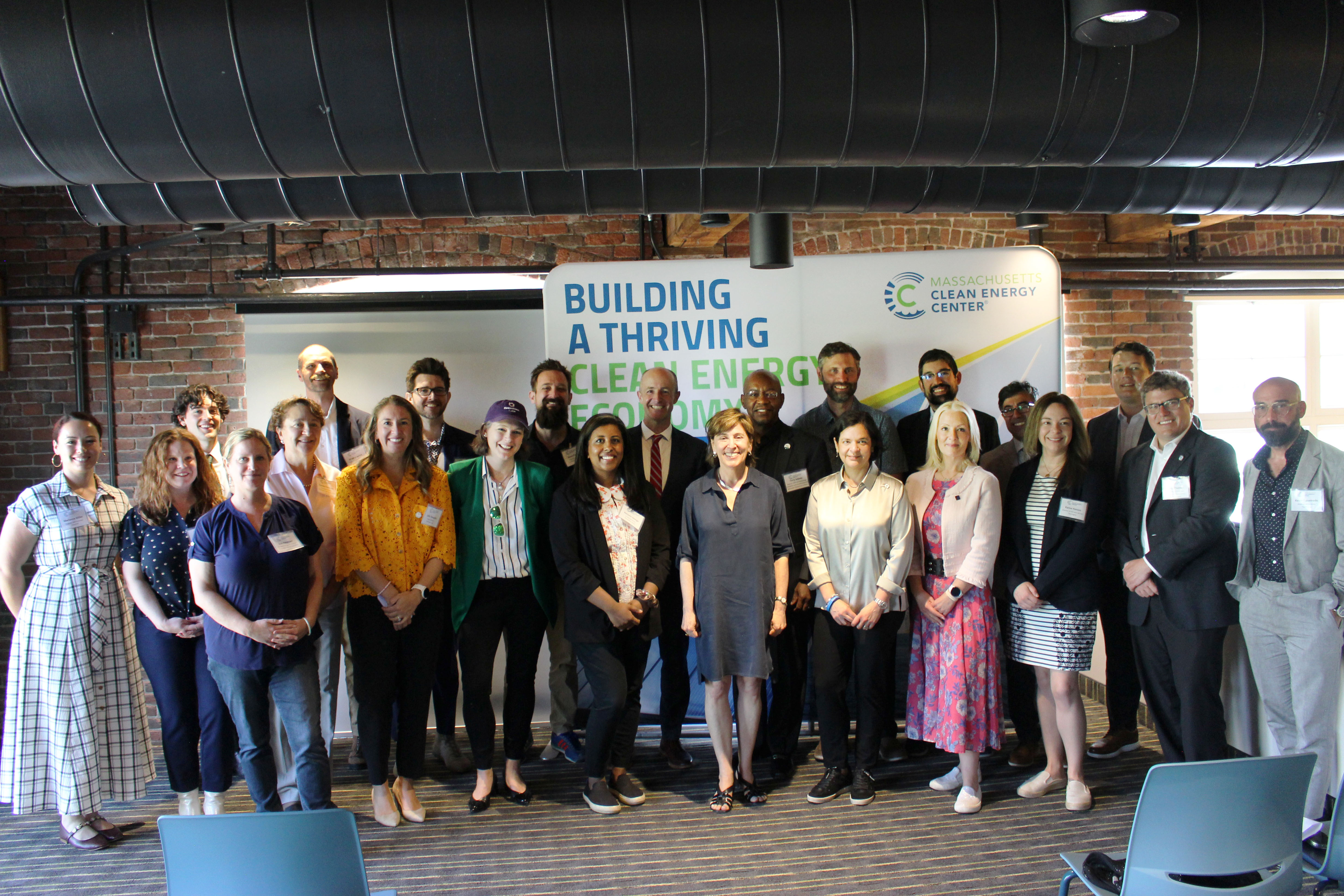
A second discussion moderated by Galen Nelson, MassCEC’s Chief Climate Officer, focused on the built environment. While innovation is advancing quickly, deployment remains uneven. From low-carbon materials to electrified systems, the technologies exist. The challenge is integrating them at scale.
Leaders across industry and academia emphasized that scaling climate solutions requires more than individual breakthroughs. It depends on coordinated systems, manufacturers, workforce pipelines, testing environments, and early adopters working together.
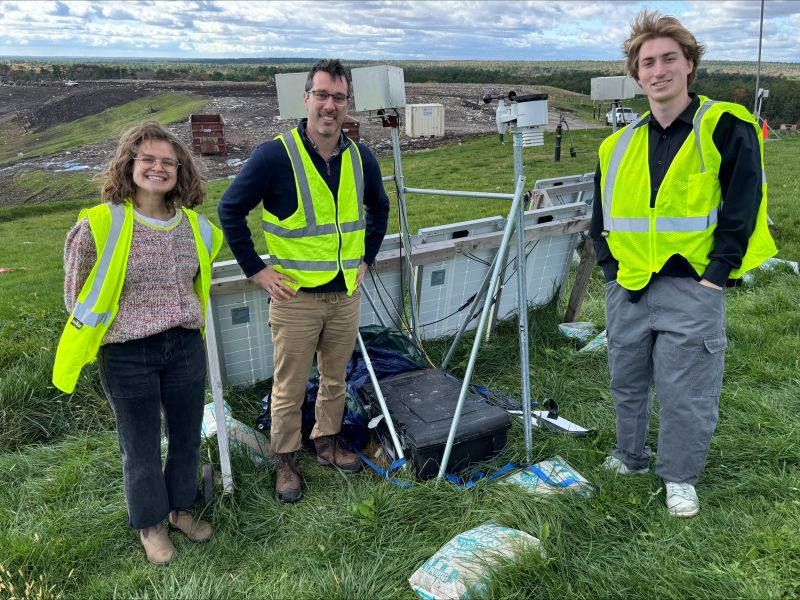
One of the clearest gaps is access to large-scale demonstration opportunities. Without places to test and validate technologies beyond the lab, companies face delays or leave for regions with stronger commercialization support.
MassCEC plays a central role in closing this gap through programs like Testing & Demonstration Assets and InnovateMass. By funding demonstration projects, convening partners, and connecting startups with corporate and institutional buyers, the organization helps transform innovation into deployable solutions.
Equally important is the role of market signals. Large buyers, universities, corporations, and public agencies can accelerate adoption by committing to new technologies and setting performance standards.
“We have the research, talent, and the companies,” Downing noted. “What we need is tighter coordination, bringing together the full ecosystem so that innovation moves faster from lab to deployment, and from pilot to market.”
Competing and Winning—the Next Decade
A third discussion moderated by Downing zoomed out to consider Massachusetts’ global position in climate tech and what it will take to maintain leadership.
The state’s strengths are clear: world-class research institutions, a dense network of startups and corporates, and a policy environment that has created sustained demand for clean energy solutions. Massachusetts is not just a place where technologies are invented, it is increasingly a place where they are tested and deployed.
But leaders also pointed to real challenges. Climate innovation is now a global competition, with other regions moving quickly to scale technologies and attract investment.
To stay ahead, Massachusetts must continue to strengthen the link between innovation and execution. That includes:
- Accelerating commercialization pathways
- Aligning policy, procurement, and market demand
- Expanding workforce development
- Investing in infrastructure, particularly grid modernization
Above all, there is a need for speed. “We’re at a moment where the pace of deployment matters as much as the quality of innovation,” said Downing. “Massachusetts has the foundation to lead globally, but we have to move faster to turn our strengths into sustained economic and climate impact.”
From Climate Week to Year-Round Action
Climate Week offers a moment to reflect but also to refocus. Across these discussions, the message was consistent: Massachusetts does not have an innovation problem. It has a scaling challenge.
The good news is that the building blocks are already in place. With continued investment in programs like Critical Mass, stronger alignment across the ecosystem, and a focus on real-world deployment, the state can accelerate the transition from breakthrough ideas to market-ready solutions.
That’s where MassCEC’s role remains critical not just as a funder, but as a connector, convener, and catalyst for growth. “Climate innovation doesn’t happen in isolation,” Downing said. “It happens when the entire ecosystem from startups to corporates to policymakers works together to move solutions forward. That’s the role MassCEC is committed to playing.”
As Massachusetts looks beyond Climate Week, the opportunity is clear: to not only lead climate technology innovation—but to define what it looks like to bring those innovations to scale.
Ready to move your climatetech solution closer to market? Explore MassCEC’s Tech-to-Market programs and resources designed to help companies test, demonstrate, commercialize, and scale climate technologies in Massachusetts.