
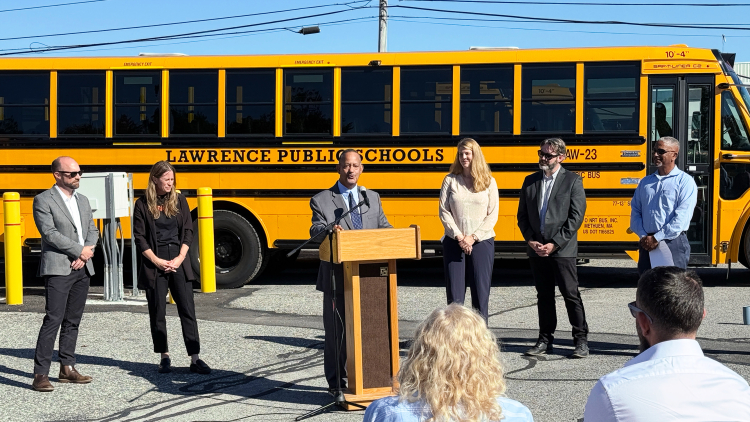
At the beginning of the 2025 school year, Lawrence Public Schools celebrated the addition and installation of 35 new electric school buses (ESBs) and the charging infrastructure that supports them. Lawrence is one of several districts supported by MassCEC’s School Bus Fleet Deployment Program, which is designed to guide school districts in transitioning to electric fleets through technical assistance and flexible funding to help close financing gaps.
Why Electric School Buses Matter For Lawrence
Lawrence, MA is a Gateway City with 100% of its residents living in an Environmental Justice block group. The adoption of electric school buses in this community will improve air quality and reduce noise pollution while ensuring greater access to clean, safe, and reliable school transportation for Lawrence students.
How the Lawrence Bus Project Began
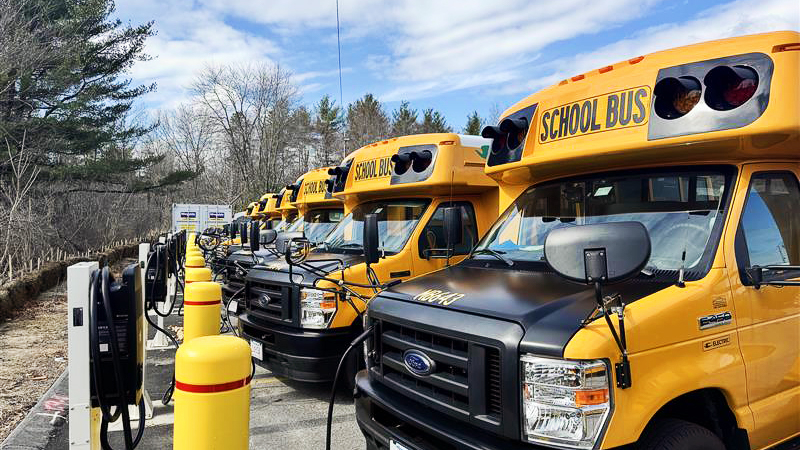
After securing a grant from the US EPA’s Clean School Bus Program, Lawrence was awarded a subsequent grant through the first round of the MassCEC’s School Bus Fleet Deployment program. In January 2023, Beacon Mobility, the company that manages Lawrence Public Schools’ fleet, and their project partner Zenobe were awarded $1,675,000 to support the deployment of 35 electric school buses and associated charging infrastructure for Lawrence Public Schools. Previously, Beacon Mobility deployed 10 electric buses in Dracut, MA. That initiative provided essential practical lessons that helped inform project design and execution in Lawrence.
Once contracted, a project team including Beacon Mobility, Zenobe, Lawrence Public Schools, and MassCEC was assembled, representing experience from each aspect of fleet electrification.
MassCEC and their technical advisor used documents, reports, and monthly meetings to support the district on several topics including:
- Procuring electric buses and charging equipment
- Planning construction and utility upgrades
- Overseeing installation and site commissioning
- Fleet comparison and analysis of total cost of ownership
Post launch, MassCEC’s involvement has continued through ongoing technical support, including vehicle performance troubleshooting and energy analysis.
Teamwork Between Project Stakeholders Led To Success
As a third-party owner and operator of the electric school buses, Beacon Mobility was able to assist Lawrence Public School District in managing this project. Instead of a project champion from the district having to manage deliverables, milestones, and paperwork, Beacon Mobility was able to take the lead. This allowed the district to focus on engaging local stakeholders and gaining community buy in.
“It was a pleasure to partner with MassCEC on Lawrence Public Schools’ electrification project and witness the operational site at Methuen turn into a resilient EV operation with 35 electric school buses (25 full-sized buses, 10 small-sized buses), charging infrastructure, and coordinated utility upgrades. The collaboration and support from MassCEC ensured that the execution was practical, transparent, and data‑driven. It gives Beacon Mobility a blueprint we’re already applying across Massachusetts and other parts of the country to scale reliable, zero‑emission transportation.”
-Manu Agarwal, Chief of Staff, Beacon Mobility
Districts that do not use a third-party bus operator are still finding success working through these projects themselves with support from the MassCEC’s suite of electric school bus programming to engage with other state and community-based organizations.
Lawrence’s Bus Operations and Charging Logistics
When approaching operations, it is important to consider which routes to electrify first, and how adding ESBs to a fleet may impact depot logistics. In this case, it was advised to electrify shorter routes first so drivers could get accustomed to the technology, and the buses’ battery range would not be a concern. This project also made use of spare electric buses which allowed the district to keep using ESBs even in the few instances of buses needing to be serviced.
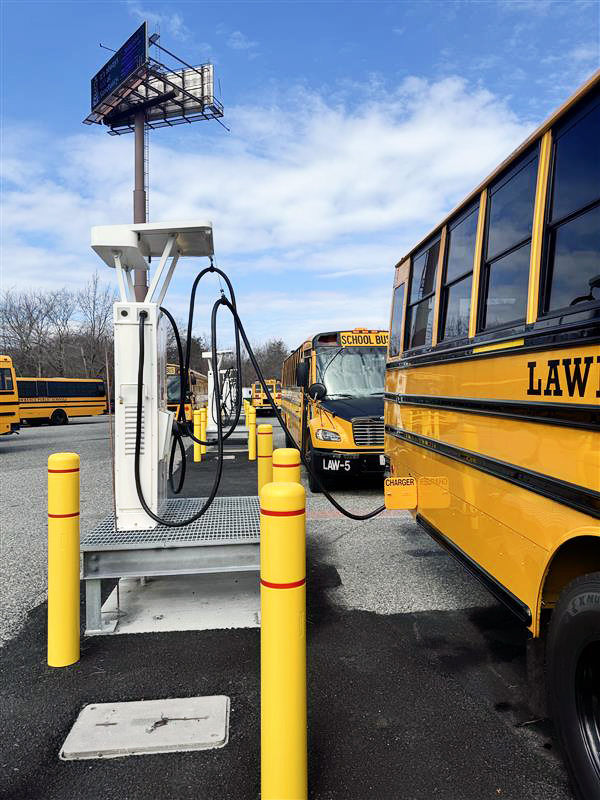
A unique feature of this school bus deployment project is the raised charging infrastructure. Lawrence Public Schools’ bus depot is in neighboring Methuen, on a lot that is near wetlands and flood prone. This meant that extra evaluation and special permits were required to install the Electric Vehicle Supply Equipment (EVSE) .To avoid a costly site relocation or risk that the expensive EVSE might sustain damage by flood waters, project partners came up with a creative solution: installing the chargers on raised platforms to allow for water to flow underneath, while keeping them accessible to all drivers.
Lawrence Public Schools’ new DC Fast chargers are uniquely installed on raised platforms to reduce risk of damage from floods. The charging cable can easily reach the bus charge port thanks to its extended length and cable retractors. These are all options districts can choose to include in their deployments if needed.
From Data to Dollars
MassCEC continues to collect data on active emissions reduction, vehicle miles traveled, and energy (kWh – kilowatt hours) dispensed. By leveraging managed charging strategies for fleets and utility rebate programs like National Grid’s Demand Charge Alternative Program, the project team is working with Beacon Mobility to implement utility cost reduction strategies. These strategies enable fleets to reduce operational expenses through their fleet electrification transition.
Challenges and Lessons Learned
Projects like this can often require the navigation of unique challenges and considerations for successful deployment. Throughout this project direct support was provided on topics like:
- Charge management strategies: Charger software integration tools help districts charge during off-peak demand hours, which can reduce electricity costs.
- District enrollment in utility rebate programs: Lawrence Public Schools enrolled in National Grid's Demand Charge Alternative program which offers tiered discounts for demand charges based on a depot’s load factor and electricity use.
- Site Design: Mitigating geographical constraints to ensure equipment is not damaged by flooding; infrastructure was built on raised platforms.
Lessons like this are important to share to help provide other districts with a road map to successful deployment.
“Together, we delivered Lawrence Public Schools with a modernized, clean and quieter fleet for students without placing the entire financial or operational burden on any one party. When public agencies and private providers share a vision and commit to make it happen, our communities win.”
— Maggie Clancy, Executive VP of Fleet Business Development, Zenobe
What’s Next
The MassCEC School Bus program is continuing to support bus electrification in MA. MassCEC currently has nineteen active projects across three rounds of funding. In addition to the Deployment program, MassCEC has a School Bus Advisory program which provides free, full fleet electrification planning to school districts and third-party operators without any required financial commitment to purchasing electric school buses. That program is currently open, accepting applications on a rolling basis.
For more information on the MassCEC School Bus program please visit
https://www.masscec.com/electric-school-bus-program-overview.
If you have any questions on the program or would like to discuss how you can participate in one of our programs, contact CleanTransportation@masscec.com.