
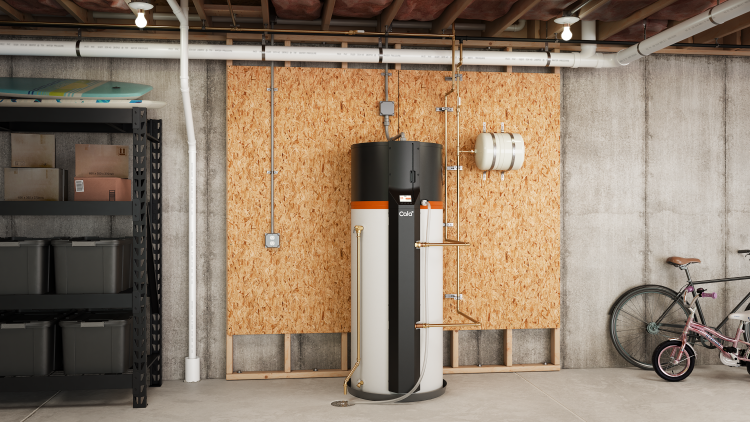
The water heater is one of the appliances that uses the most energy at home, but few people give much thought to how it works or how efficiently it uses energy.
According to U.S. Department of Energy statistics, water heating accounts for nearly 20% of the average home’s energy use in the United States, making it one of the largest opportunities for households to improve energy efficiency. Many conventional water heaters still rely on basic controls that respond to demand rather than anticipating it and may not coordinate with solar generation, electricity rates, or other home energy resources.
Massachusetts-based Cala Systems is aiming to change that. The company designs, assembles, and sells intelligent heat pump water heaters that use predictive software — which Cala calls Predictive Intelligence™ — to learn a home’s hot water needs and determine when to heat water. The goal is to provide enough hot water when people need it while using less electricity and taking advantage of times when electricity may be cheaper or cleaner.
A tank full of hot water can also store energy in the form of heat, allowing a water heater to function in some ways like a thermal battery.
Better Efficiency Through a More Intuitive Water Heater
Cala’s system combines a heat pump with predictive software and several pieces of specialized hardware. The system determines when, how quickly, and to what temperature to heat water. A variable-speed compressor controls how quickly the system heats, a flow sensor tracks hot water use, and an integrated mixing valve helps manage the temperature delivered to the home.
Together, these components allow the system to anticipate periods of higher hot water demand and adjust heating accordingly, rather than simply reacting to hot water use as it happens.
For homeowners, that can mean less time spent choosing between settings such as “Eco,” “Hybrid,” or “High Demand.” Cala’s controls adjust heating based on household patterns, preparing for periods when hot water is likely to be needed.
The system can also work with other home energy systems and change when it uses electricity. For a home with rooftop solar, for example, Cala can coordinate water heating with solar production. It can also respond to time-of-use electricity rates, which charge different prices depending on when electricity is used.
This flexibility becomes more important as more homes switch to electric heating and as the electric grid adds more renewable power. If water heaters can use electricity at different times, some of that demand can move away from periods when the grid is busiest.

An Everyday Appliance Becomes a Grid Resource
Cala’s idea for a smart heat pump water heater grew out of CEO and cofounder Michael Rigney’s work in thermal engineering, demand response, and virtual power plants. He saw that a water heater could do more than provide hot water. It could also store energy in the form of heat and respond to conditions on the electric grid.
Cala launched its first product in September 2025 after completing research and development and industry safety certifications. The company now operates a 25,000-square-foot manufacturing facility in Wilmington, Massachusetts, and has shipped hundreds of units across the country.
Cala’s deployed systems have collectively logged more than 100 years of real-world operation, giving the company data on how its technology performs in everyday use and where it can continue to improve. The company reports 99.7% hot-water reliability — meaning water is delivered at the target temperature — and says the heat pump provides 93% of all heating in its systems, compared with about 65% for traditional systems. Its systems have also been connected to rooftop solar, time-of-use rates, or both in about one-third of deployed units.
Those early installations are giving Cala data about how its system performs in real homes, where hot water use can vary from day to day.
The company reports annual savings of about $529 for a typical family of four replacing an electric-resistance water heater at the national average electricity rate. In higher-cost markets such as New England, Cala estimates annual savings could reach about $954, though actual savings depend on factors such as the home itself, the existing water heater, electricity rates, and how much hot water the household uses.
Growing Manufacturing and Market Reach
Cala’s growth has also been supported by MassCEC. The company received Catalyst and InnovateMass awards that funded early proof-of-concept, prototyping, and pilot work. In 2024, Cala raised $5.6 million in its Seed I funding round, led by MassCEC alongside other investors. Cala has also participated in MassCEC’s Clean Energy Internship Program.
These resources have helped Cala advance its product development, manufacturing, and commercial growth. The company reports that it has raised more than $15 million and reached approximately $2 million in annual recurring revenue. Its Wilmington facility can produce more than 15,000 units annually, and Cala employs about 25 people in Massachusetts across engineering, software, manufacturing, and clean energy roles.
Cala is also building the workforce needed to install its products. Its Cala Pro Network includes more than 150 trained contractors, with coverage across 46 states. The company says it is adding roughly 20 to 30 contractors each month.
“MassCEC has been instrumental in the growth and success of Cala to date,” said Mike Ting, Cala’s VP of Hardware and cofounder. “Between various MassCEC grants, direct VC funding, and resource support via the Clean Energy Internship Program, MassCEC has fueled Cala’s growth since founding.”
An Exciting Future for a Seemingly Boring Appliance
Cala is now focused on expanding beyond its first residential product. The company plans to develop both 50- and 80-gallon models, enter additional water-heating categories, and increase production at its Wilmington facility.
It is also working to improve its software, mobile app, and connections with rooftop solar, batteries, and changing electricity prices. In the long term, the company plans to connect groups of water heaters to utility demand-response and virtual power plant programs.
The opportunity is large. About 10 million water heaters are sold in the United States each year, according to Cala. The company sees the millions of water heaters already installed in American homes as a potential network of flexible energy storage.
For Massachusetts homeowners, that vision starts with something familiar. A water heater heats water. Cala’s goal is to make it smart enough to anticipate when that water will be needed and when it makes sense to use electricity to heat it.
If the company can continue to scale that approach, an appliance that has spent decades quietly sitting in the basement could become a more active part of a stronger electric grid and more energy-efficient homes across the country.
For the latest news from Cala, check out their website and LinkedIn page. To learn more about MassCEC’s cutting-edge portfolio companies, visit the MassCEC Investments page.