
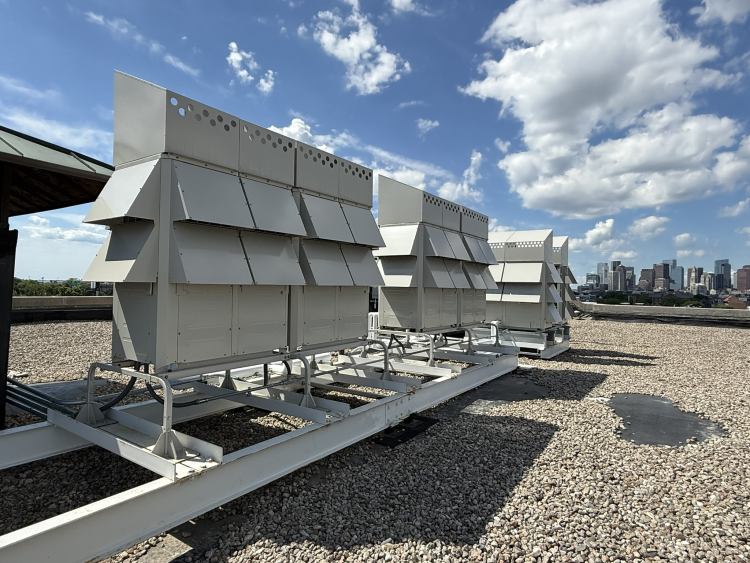
Buildings are some of the biggest energy users and a leading source of air pollution in Massachusetts. The Mass Clean Energy Center’s Green School Works program supports K–12 public schools in installing and maintaining clean energy infrastructure, helping schools modernize their buildings, reduce energy costs, and create healthier, more energy-efficient learning environments.
Supporting schools’ participation in the clean energy transition can help reduce broader environmental impacts while delivering meaningful benefits to the people who use these buildings every day. Across the state, school electrification projects—particularly upgrades to heating, ventilation, and air conditioning (HVAC) systems—are creating healthier and more comfortable indoor environments for students and teachers, with important implications for student health and learning.
Inefficient, Outdated Systems
Effective mechanical ventilation and thermal regulation systems are needed for students to succeed, but such systems are inadequate in many Massachusetts schools. Nationally, an estimated 41% of public school districts need to update or replace the HVAC systems in at least half of their schools, according to the U.S. Government Accountability Office.
Over 50% of public school buildings in Massachusetts were built before 1970. Many districts are working with aging school infrastructure that presents their own unique challenges. Among Boston Public Schools’ buildings, for example, over half were built before World War II, and only about a third of them have comprehensive heating, cooling, and ventilation systems.
In 2025, 17% of public schools in Massachusetts still lacked any kind of cooling system, and many schools, especially older ones, lack ventilation systems and rely on opening windows as their primary method of ventilation.
School operations staff point to a chronic lack of funding as a primary reason for not being able to upgrade HVAC systems. These challenges are often greatest in low-income communities and communities of color, where students are more likely to attend schools affected by years of underinvestment.
Indoor Air Quality and Health
An extensive body of research links thermal conditions and indoor air quality in schools to student health and learning.
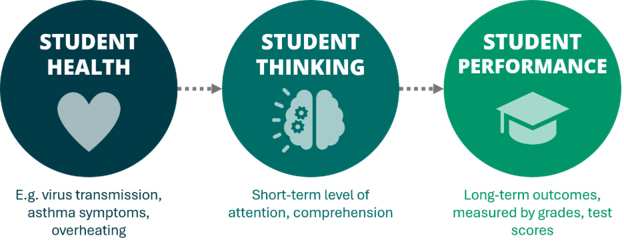
The Schools for Health report from Harvard’s Chan School of Public Health explains that student health is foundational for student thinking, which consequently impacts academic performance. For every day that a student is in a classroom that is too hot or is not properly ventilated, there are direct impacts on their attention and comprehension. Over time, the impact is visible in measures of student performance, like grades and standardized test scores.
Ventilation — dispelling stale air and exchanging with outside air — and air filtration are crucial in protecting students from two kinds of pollutants. They both help manage internal pollutants, like virus particles, dust, excess carbon dioxide from occupants, and chemicals from school supplies and building materials. Air filtration also helps manage external pollutants, including allergens like pollen, wildfire smoke, and particles emitted by nearby vehicles.
Without these systems reducing the pollutants in the air, students can suffer from greater rates of virus transmission, allergy symptoms, aggravated asthma, and other health impacts. Researchers have observed a 5% decrement in students’ “power of attention” in poorly ventilated classrooms, which is roughly equivalent to the impact of skipping breakfast. Student health issues caused by poor indoor air quality can lead to absenteeism, preventing students from accessing their education altogether.
Heat and Thermal Comfort
Thermal comfort within the building is especially important for schools. Children have higher baseline metabolic rates, higher core body temperatures, and have a weaker ability adjusting to new climates than adults do. Heat and cold stress in students can impact memory and reasoning skills, and hot or humid conditions can also exacerbate other health conditions. A 2018 study of ten million PSAT-takers showed that hotter school days in the year prior to the test reduced learning. Their data suggest that without air conditioning, each 1°F increase in school year temperature reduces the amount learned that year by 1%.
The increasing frequency of school days with extreme heat has begun to directly disrupt time in the classroom. In the last few years, particularly toward the end of the school year, many districts have had to dismiss students early or cancel school entirely due to heat and a lack of air conditioning.
Scott Hemlin is the principal of Ralph C. Mahar Regional School in Orange, MA, which is installing new unit ventilators with integrated heat pumps and cooling capability in 24 classrooms with the support of a Green School Works grant.
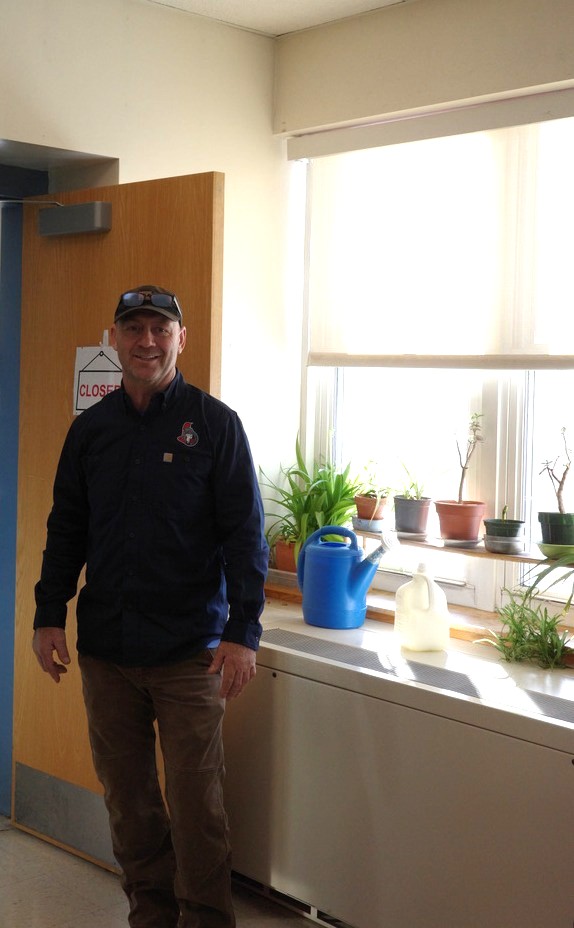
“I think human comfort plays a significant role in day-to-day performance [and] day-to-day interactions,” he said. “In this building, before those rooms had AC units in there, they would get so hot during the day, especially the days leading up to summer vacation. There were times when teachers had to take their kids outside and try to find some cooler spots, and that just disrupts education.”
He also explained how conditions over the years had been problematic for students and teachers with certain medical needs that make them sensitive to extreme temperatures and humidity.
Inequitable building conditions lead to disproportionate impacts on low-income and students of color. Hot school days are estimated to be responsible for 5% of the gap between standardized test scores of students of color and their white counterparts. Asthma, which is responsible for about 13.8 million missed school days per year in the United States, places a disproportionate burden on children living in households below the poverty threshold.
The Solution: Modern, Electric HVAC
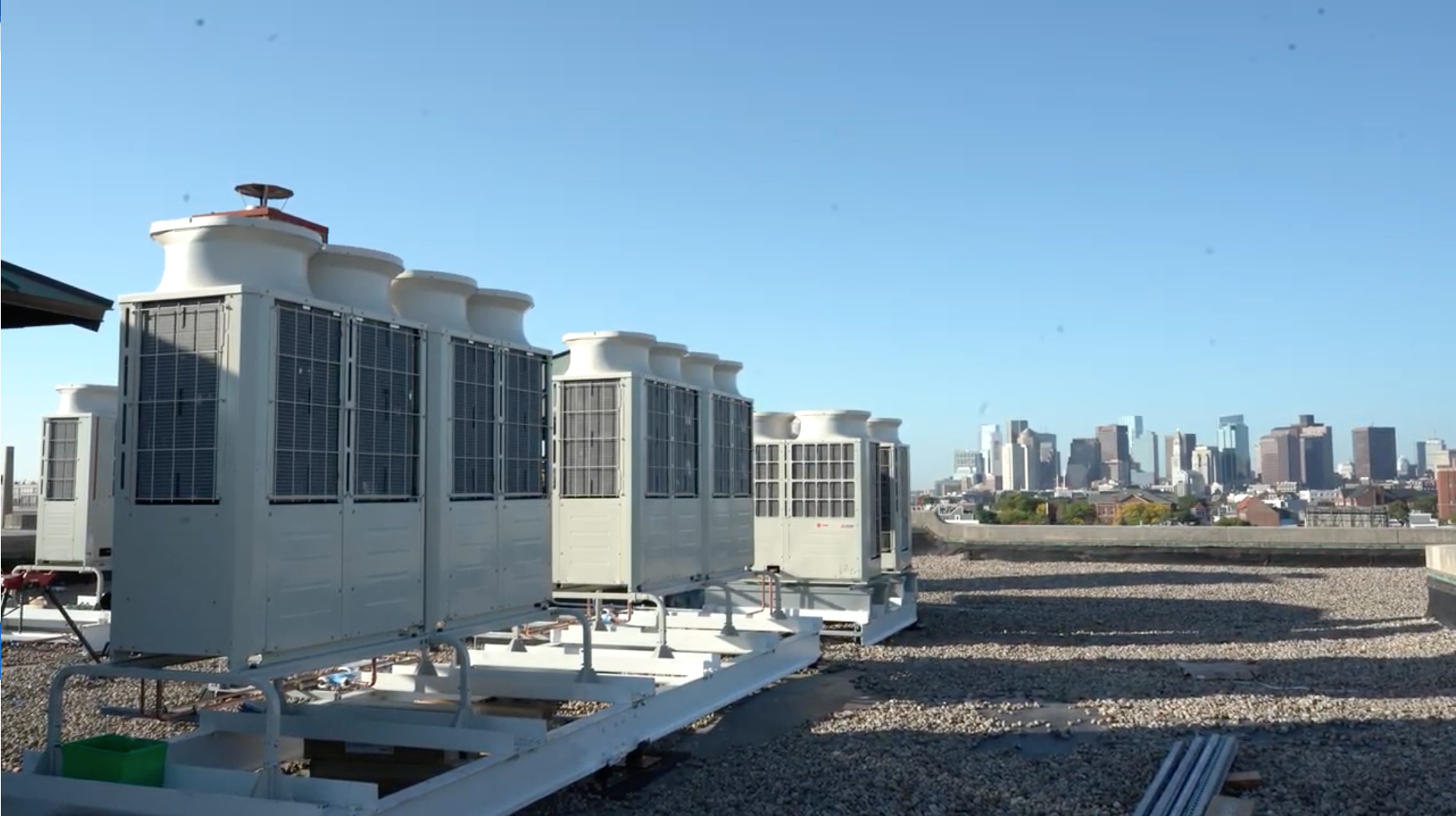
All-electric, high-performance HVAC systems are a chance to improve building conditions for students and teachers while reducing fossil fuel pollution, improving energy efficiency, and cutting costs for districts.
HVAC systems powered by heat pumps work by transferring heat rather than creating it. They are capable of both efficient cooling and heating, which allows for better temperature control. Modern systems can also support high-performance ventilation and filtration for improved day-to-day air quality. In making the switch to electric equipment, schools also eliminate the local air pollution associated with burning fossil fuels on site and mitigate risks to safety like gas leaks and carbon monoxide exposure.
Improving Building Experience and Student Outcomes
A 2025 study of the effectiveness of various school capital investments found that replacing or upgrading HVAC systems produced the largest academic gains. HVAC upgrades allow students to breathe cleaner air and stay healthy, avoid missed instructional time as average temperatures rise and heat waves become more common, and thrive in comfortable environments for learning.
This year, with support from a Green School Works grant, Boston Public Schools completed an HVAC electrification at Otis Elementary School in East Boston, bringing modern cooling, ventilation, and air filtration systems to the 121-year-old building.
“We’ve even heard from the [Otis] school nurse that students calling in sick has gone down,” said Oliver Sellers-Garcia, the Green New Deal Director and Commissioner of the Environment Department for the City of Boston. “A lot of people say that it just feels more comfortable, and if that’s how you’re spending eight hours of your day, that affects your whole life, your whole day — and that’s incredible. A healthy building is absolutely critical, given that we spend 90% of our time inside buildings. That’s what urban humans do.”
Katherine Walsh is the Director of Planning, Engineering, Sustainability & Environment at Boston Public Schools. “We also heard from a teacher who grew up with asthma, and was often hospitalized with asthma issues, that she’s noticed she hasn’t gotten sick this year like she would normally in the spring, and just has felt more comfortable and safe,” she said. Walsh’s team also heard from the school that students didn’t suffer from allergies as badly last spring as they typically do, since teachers didn’t have to open their windows for ventilation.
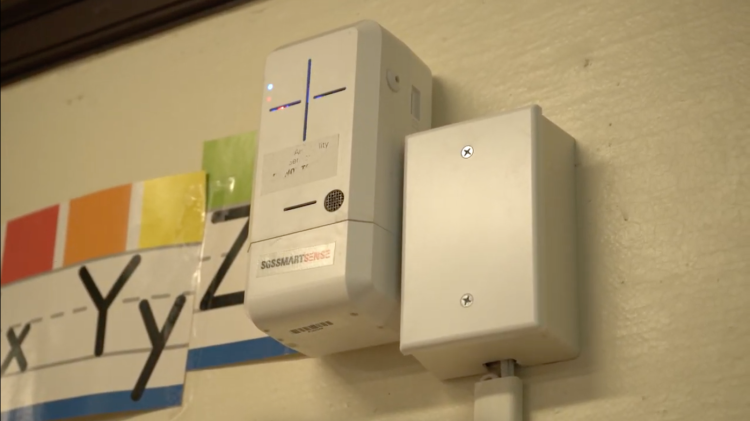
Indoor air quality is a top priority for BPS. Thanks to ESSER funding, Walsh and her team deployed a first-of-its-kind district-wide indoor air quality monitoring program, with sensors installed in every classroom across the district. The data is reported live through a public online dashboard, and the district uses it to make evidence-based decisions to improve their facilities in the interest of health and wellbeing. The BPS team and Boston University School of Public Health developed a research partnership around this ground-breaking work, and are looking forward to analyzing the air quality data before and after the upgrades at the Otis, along with student health and absenteeism data, to quantify the project’s benefits for student health and learning.
Building Better Schools
From Boston to Orange, there is a growing statewide effort to invest in more efficient energy systems and make school buildings healthier for students and teachers. Ian Spencer, Facilities Director for the Ralph C. Mahar Regional School District, managed the Green School Works-funded project at Ralph C. Mahar Regional School. “We are working hard to provide a better educational environment and do what we can to promote success in every way, not just in the classroom with curriculum and teachers, but in less conventional ways as well,” he said.
To date, Green School Works grants are enabling HVAC electrification and upgrade projects at 24 public schools, among other clean energy projects. To learn more about the Green School Works program’s grant and technical assistance awardees and offerings for K-12 public schools across the state, visit the Green School Works page.