
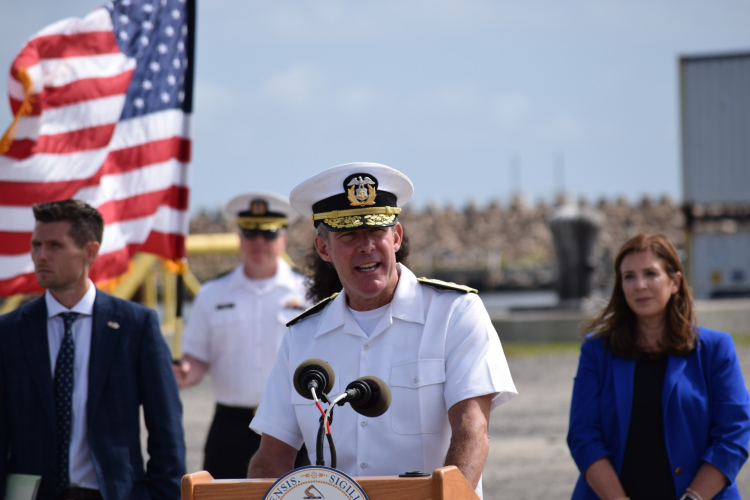
President of Mass Maritime Academy brings decades of workforce and higher education leadership to our Board of Directors.
Rear Admiral Francis X. McDonald has spent his career preparing the next generation of engineers, mariners, and technical leaders for industries that power Massachusetts. As president of Massachusetts Maritime Academy and a member of the Mass Clean Energy Center Board of Directors, he brings a unique perspective at the intersection of energy, workforce development, and public higher education.
McDonald’s experience spans both the commercial energy sector and academia, giving him firsthand insight into how education can help meet the evolving needs of Massachusetts’ economy. On the MassCEC Board, he helps advance strategies that strengthen the state’s clean energy workforce while supporting innovation across the sector.
A Career Rooted in Energy and Education
A graduate himself from Massachusetts Maritime Academy in 1985 with a degree in marine engineering, McDonald began his career in the commercial nuclear power industry. Although he initially expected to work at sea, a slowdown in the shipping industry led him to pursue opportunities in commercial energy, where he spent nearly a decade developing technical expertise in power generation.
Throughout that time, he maintained close ties to his alma mater. When an opportunity arose to return to Massachusetts Maritime Academy to build its cooperative education program, he saw a chance to combine his industry experience with his passion for student success.
“It was the connection of Mass Maritime and the shoreside energy industry,” McDonald said. “I loved it.”
Since returning to the academy, McDonald has served in several leadership roles, including director of cooperative education, dean of enrollment management, vice president for operations and executive vice president. He became president in 2015 after unanimous approval from both the academy’s board of trustees and the Massachusetts Board of Higher Education.
Preparing Students for the Energy Workforce of Tomorrow
Throughout his leadership, McDonald has emphasized the importance of aligning higher education with the state’s workforce needs.
While Massachusetts Maritime Academy is widely recognized for preparing ship captains and marine engineers, its graduates also play critical roles across the energy sector, advanced manufacturing, life sciences, and facilities management. Many oversee complex industrial systems, power plants, and critical infrastructure throughout the state.
“We might not graduate the scientists moving molecules around,” McDonald said, “but we graduate a ton of process engineers keeping all those plants running for Pfizer, for Takeda, for Boston Scientific.”
That workforce-focused approach has naturally extended into clean energy.
Over the past decade, Massachusetts Maritime Academy has expanded opportunities for students to gain hands-on experience with renewable energy technologies and sustainable building systems. The campus includes LEED Platinum facilities featuring solar photovoltaics, geothermal heating and cooling systems, and other high-performance technologies that serve as living laboratories for students.
The academy’s ongoing campus geothermal project continues that commitment by modernizing existing facilities, while providing real-world learning opportunities in emerging clean energy technologies.
Supporting MassCEC’s Mission
McDonald’s interest in serving on the MassCEC Board grew from the academy’s longstanding partnership with the organization and his commitment to public service.
In 2018, MassCEC supported the installation of the academy’s shoreside wind turbine, helping create new educational opportunities while advancing campus sustainability. As he looked for additional ways to contribute to the state, serving on the CEC board offered an opportunity to represent both Massachusetts Maritime Academy and the broader public higher education community.
“I wanted to represent Massachusetts Maritime, but also the broader state university system,” he said.
Today, McDonald helps bring a workforce development perspective to board discussions, connecting the needs of employers with the educational pathways that prepare students for clean energy and climate technology careers. He also views higher education institutions as important partners in advancing the state’s economic development and climatetech innovation.
Leading by Opening Doors
McDonald remains optimistic about the future of clean energy in Massachusetts, even as the industry navigates changing market conditions and evolving federal policies.
He credits the Healey-Driscoll Administration’s sustained investment in climate innovation with helping establish Massachusetts as a national leader while creating new opportunities for businesses, workers, and communities.
Looking ahead, he believes the state’s energy future will require a diverse portfolio of technologies, including offshore wind, energy storage, hydropower, and advanced nuclear energy, working together to deliver reliable, affordable, and lower-carbon electricity.
“We need organizations like the Clean Energy Center, who can be a convener, a bit of an incubator, and a funder to get things rolling, and it’s important to help train these young people,” he said. “I hope my position adds some value there.”
Through his service on the MassCEC Board of Directors, McDonald helps advance its mission to grow a thriving clean energy economy that benefits all Massachusetts residents. By connecting education with industry needs and expanding pathways into high-quality careers, he is helping ensure the state has the talent, innovation, and leadership needed to meet its climate and economic innovation goals for years to come.
Click here for more information about the CEC’s Board of Directors.